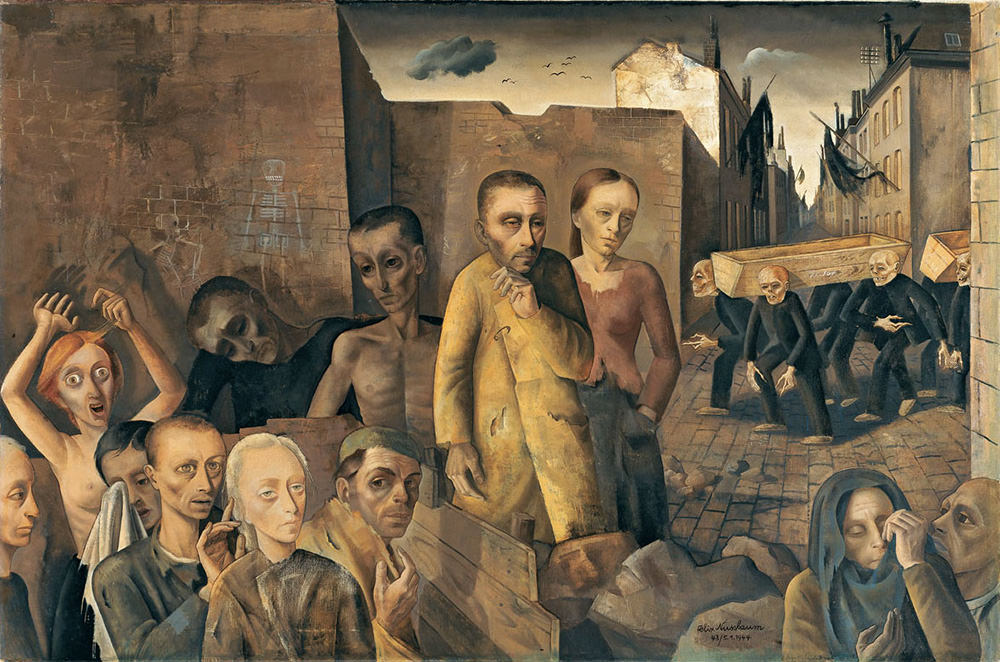
Felix Nussbaum’s *The Damned* confronts the viewer with a crowded street of hollowed faces and tense bodies, pressed together as if there is nowhere left to move. The palette is muted and ashen, and the figures’ wide eyes and clenched hands suggest panic, exhaustion, and resignation all at once. Rubble-like forms and harsh, angular walls turn the setting into a claustrophobic maze, where even the sky feels heavy.
At the center, a couple stands in uneasy stillness, their posture more defensive than intimate, while around them others huddle, stare, or avert their gaze. On the right, men carry a coffin through the narrow lane, a blunt procession that makes death feel routine and unavoidable, not ceremonial. The street recedes into a corridor of damaged buildings and sharp shadows, amplifying the sense of entrapment that defines the entire composition.
Reading this painting today, it works both as a powerful artwork and as a visual document of fear—one that speaks to persecution, displacement, and the stripping away of ordinary life. For a WordPress post exploring Felix Nussbaum, *The Damned* offers rich material: expressionist distortion, symbolic staging, and an emotional intensity that lingers long after the first glance. It’s the kind of image that rewards slow looking, because every face and gesture seems to carry its own quiet testimony.