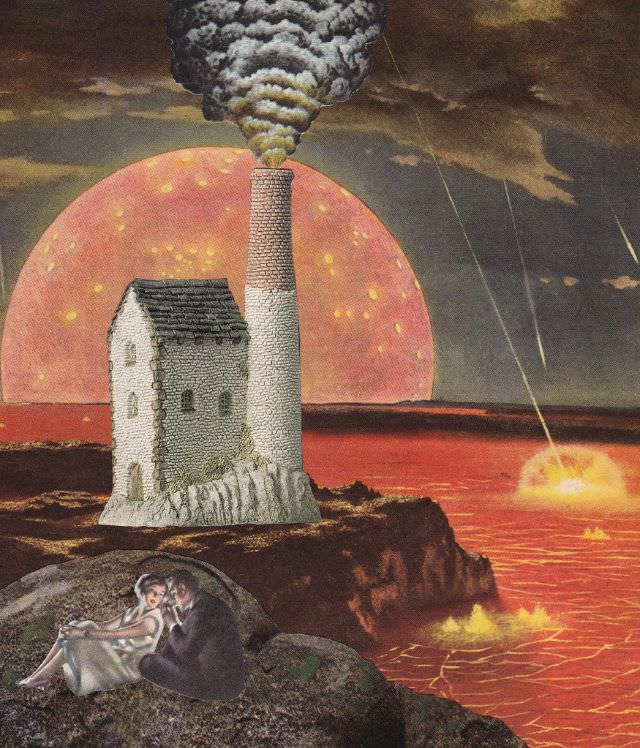
A squat stone engine house and its tall chimney stand like a last witness on a rough headland, sending a thick plume into a sky already bruised with cloud. Behind it, a swollen, fiery orb hangs low on the horizon, turning the sea to a molten red and making the shoreline feel less like Cornwall and more like the planet’s first breath. The title’s wry suggestion lands immediately: here, smoke belongs to deep time as much as to industry.
Closer down on the rocks, two small figures huddle beneath a makeshift shelter, their pale clothing and anxious closeness sharpening the sense of vulnerability. Streaks slash through the air like meteors, and bright bursts flare on the water as if the ocean itself is taking impacts. It reads as an artwork that borrows the language of geological formation—heat, fallout, and ash—to reframe the Cornish tin mine as part of a larger, stranger creation story.
For readers drawn to mining history, industrial heritage, and imaginative period illustration, this piece offers a memorable collision of themes: human labor set against a mythic, almost apocalyptic seascape. The familiar silhouette of a mine chimney becomes a beacon in a world where the earth seems newly forged, and the “smoking” of the title starts to feel both literal and metaphorical. As a WordPress post, it’s a striking conversation-starter about Cornwall, tin mining, and the way artists turn landscapes into legends.