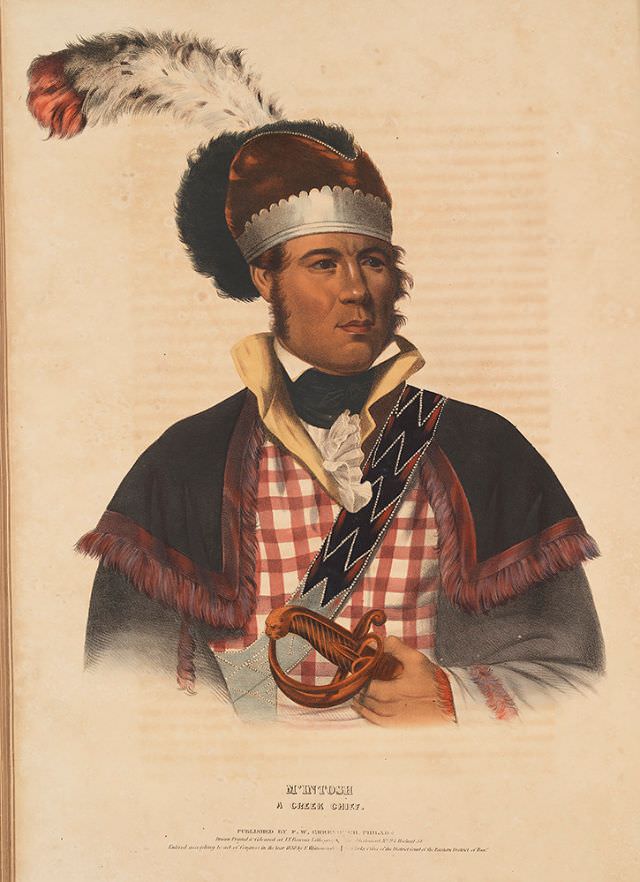
M’Intosh appears here in a carefully composed portrait that balances dignity with detail, presenting a Creek chief in formal dress against a quiet, uncluttered background. The artist’s attention goes straight to the face—steady gaze, strong features, and a calm expression that reads as resolute rather than posed. Below the figure, the printed caption “M’INTOSH — A CREEK CHIEF” anchors the identity of the sitter in the language of the period.
Clothing and adornment carry much of the story: a feathered headdress with a pale band, a dark wrap edged with fringe, and a bold checkered garment beneath, all rendered with crisp pattern and controlled color. A zigzag strap crosses the chest, and the hand rests on a curved-hilt sword, a striking detail that hints at diplomacy, status, and the complicated intersections of Native leadership with colonial and American power. The overall effect is both ceremonial and political—an image meant to be read as much as admired.
For readers searching Native American history artwork, Creek Nation portraits, or early American visual culture, this print offers a revealing example of how Indigenous leaders were represented for wider audiences. It invites a closer look at how regalia, European-style elements, and portrait conventions were used to communicate authority and identity. As part of a broader collection of historical artworks, “M’Intosh, A Creek Chief” stands as a reminder that portraits are never only likenesses—they are arguments about who mattered, and why.