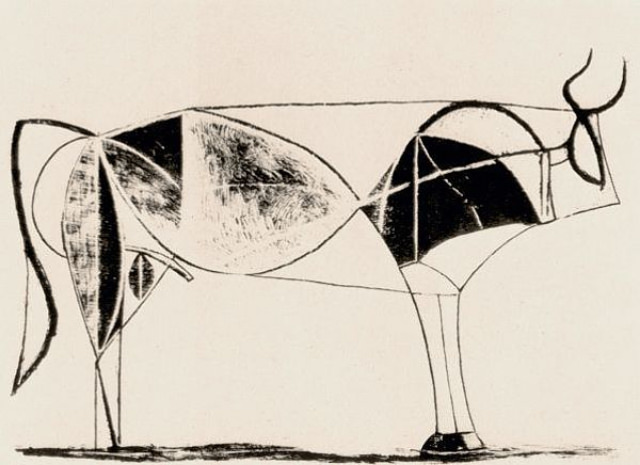
Plate 7 arrives at the moment when construction begins to disappear, leaving the bull’s weight and rhythm to speak for themselves. Broad, confident black shapes settle into the body while the earlier scaffolding of guiding lines is pared back, a visual record of an artist testing what can be removed without losing the animal’s presence. The result is neither fully naturalistic nor fully abstract, but poised between the two in a way that makes the process feel immediate.
Across the pale ground, the bull is built from intersecting arcs and crisp angles: a sweeping back, a tightened flank, and slender legs that read like measured supports. The head is reduced to a few decisive marks—horns, muzzle, and the suggestion of a profile—yet the stance remains unmistakable, grounded by a dark shadow at the feet. That balance of form and economy is the real subject here, as much as the bull itself.
For readers interested in Picasso’s studies of simplification and the evolution of a motif, this artwork offers a clear lesson in how modern drawing can honor structure while shedding excess. The plate highlights a key step in the famous bull sequence, where line becomes decision and every mark carries responsibility. As a historical art image for a WordPress post, it pairs well with discussions of abstraction, draftsmanship, and the enduring symbolism of the bull in twentieth-century art.