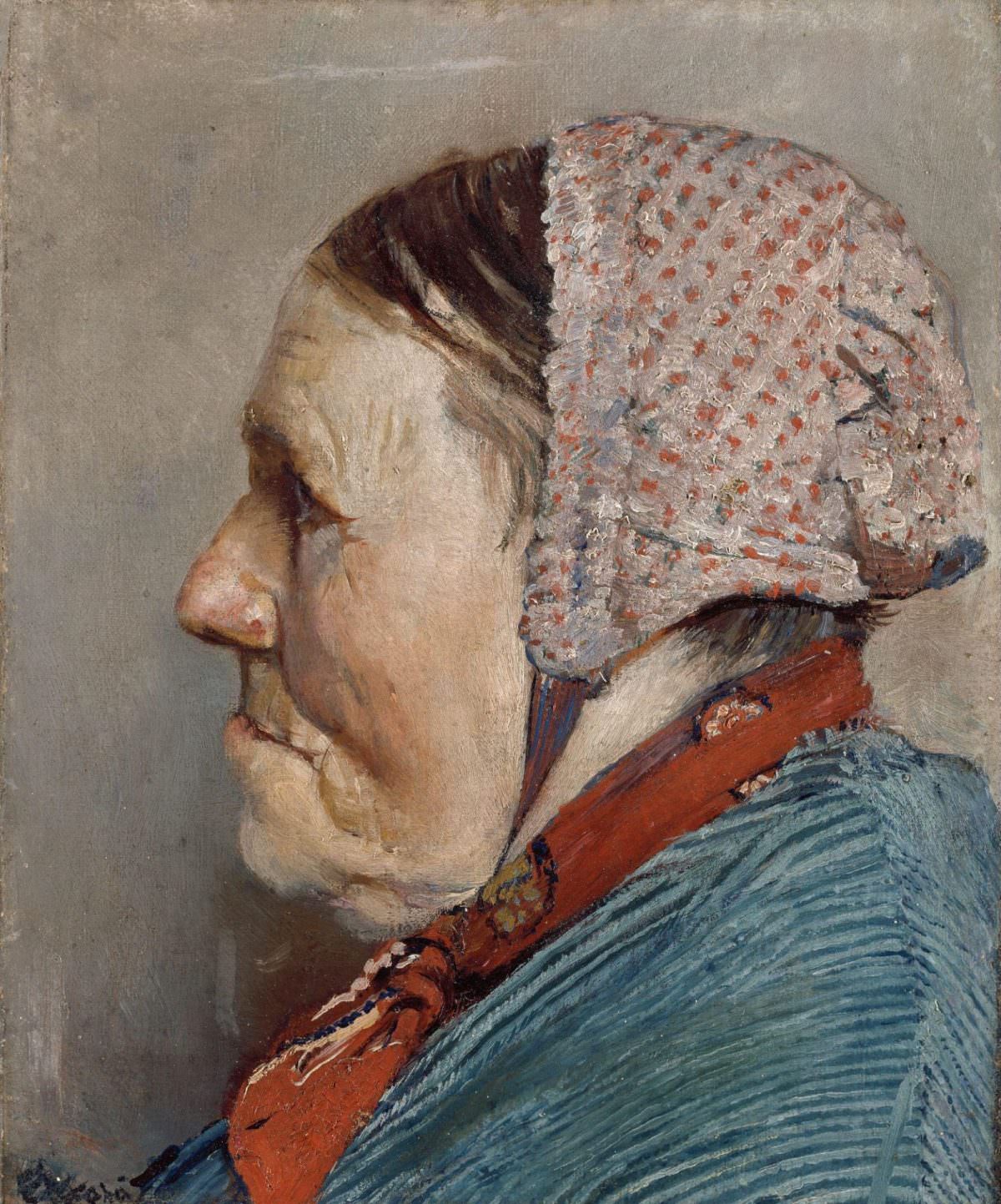
Rendered in close profile, the *Portrait of Ane Gaihede, 1888* draws the viewer into a quiet, intimate encounter with its sitter. The face is modeled with careful attention to age and character—soft folds at the jaw, a strong nose, and a faraway gaze that suggests a life shaped by experience rather than theatrical pose. Against a plain, muted background, nothing competes with the subject’s presence, making this 19th-century portrait feel strikingly direct.
What lingers is the tactile language of clothing: a patterned headscarf speckled with tiny red accents, a warm red neckerchief, and a blue garment worked with visible strokes that mimic woven fabric. The artist’s brushwork shifts from delicate handling around the eyes and cheek to broader, more energetic paint on the shoulder, letting texture tell part of the story. Color is restrained yet purposeful, guiding the eye from the pale skin to the bright scarf and back again.
As an artwork dated 1888, this portrait sits within a period when everyday dress and ordinary lives were increasingly treated as worthy subjects of fine art. The lack of props or elaborate setting emphasizes dignity over status, inviting modern readers to consider what portraiture preserves: not just likeness, but the silent evidence of work, weather, and time. For anyone searching for historical portrait art, 19th-century painting, or the visual culture of the late 1800s, Ane Gaihede’s profile offers a compelling, human-scale window into the past.