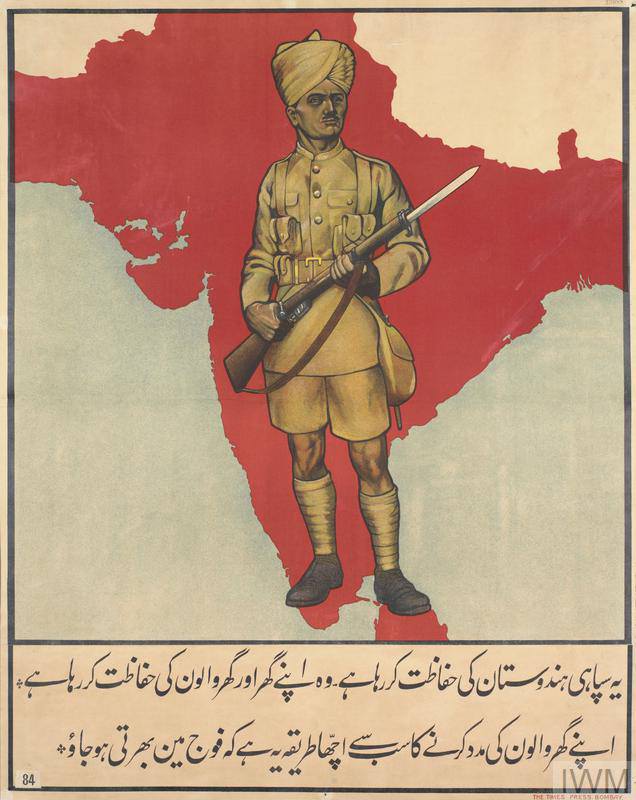
Against a bold red silhouette of the Indian subcontinent, a lone soldier stands in full kit, rifle held across his body with a fixed bayonet that turns the pose into a clear statement of readiness. His turban, belted tunic, ammunition pouches, and puttees are drawn with the crisp precision of a recruitment-era illustration, designed to be read at a glance. The pale surrounding background makes the figure and map feel inseparable, as if the defender and the land are one image.
The title, “This Soldier is Defending India,” fits the artwork’s message of duty and protection, using simple visual language to link individual service to national security. The soldier’s forward gaze and solid stance convey resolve rather than action, suggesting vigilance—watching, guarding, enduring. Along the bottom, a line of Urdu text anchors the poster in its intended audience and adds the persuasive cadence typical of wartime public messaging.
Viewed today, the piece offers more than a striking composition; it opens a window onto how military service and loyalty were publicly framed through poster art. For readers searching for historical Indian military posters, wartime propaganda artwork, or Urdu-script ephemera, this image is a vivid example of how illustration, typography, and geography were combined to shape sentiment. It remains a powerful artifact of visual storytelling, where uniform details and map symbolism work together to argue that defense of the land begins with the steadfast figure at its center.