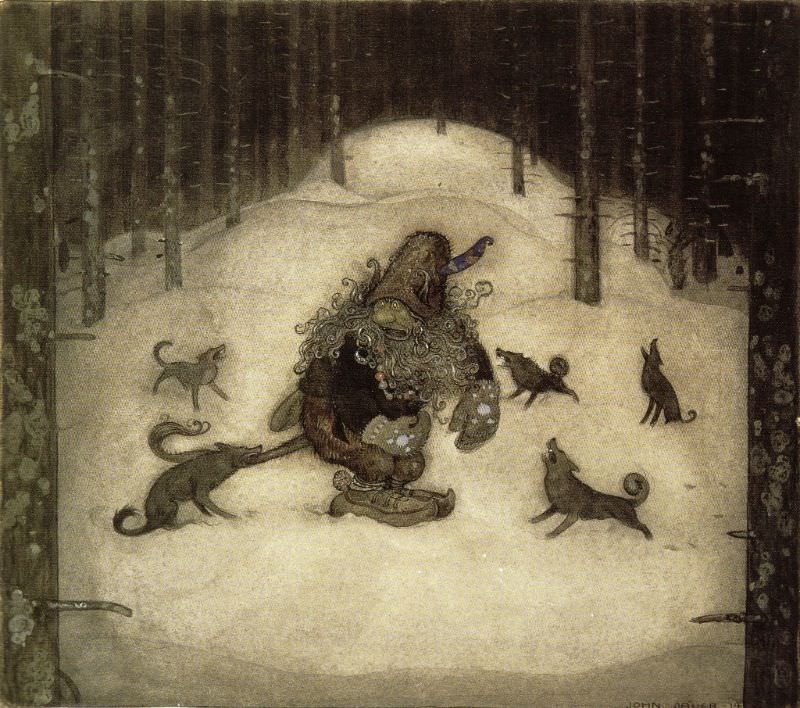
Deep in a snow-blanketed forest, a hulking “Mother Troll” kneels as if caught mid-errand, her shaggy silhouette and curling beard rendered with a storyteller’s relish. A few sharp, dark tree trunks frame the pale clearing, making the central figure feel both hidden and strangely spotlighted. Around her, small animals—foxlike and doglike shapes—circle at varying distances, lending the scene a sense of wary curiosity and winter hush.
The title, “When Mother Troll Took in the King’s Washing,” hints at a folktale moment where the everyday meets the uncanny: royal laundry handled by a creature of the wild. That domestic detail softens the monster, turning menace into labor, and the artist plays with that tension by placing the troll low to the ground, absorbed in her task. The limited palette and grainy, aged surface read like an early 20th-century illustration, and the year 1914 anchors it to an era when Nordic fairy-tale imagery and decorative art thrived in print and exhibition.
For readers drawn to historical art, folklore illustration, and winter forest scenes, this artwork offers an evocative blend of humor and unease—part nursery tale, part wilderness myth. It’s also a reminder that “historical photos” in archives often include photographed artworks: images meant to be circulated, studied, and remembered. Whether you arrive for the troll, the king, or the promise of a strange domestic adventure, the composition invites a closer look at every shadow, paw print, and curl of hair in the snow.