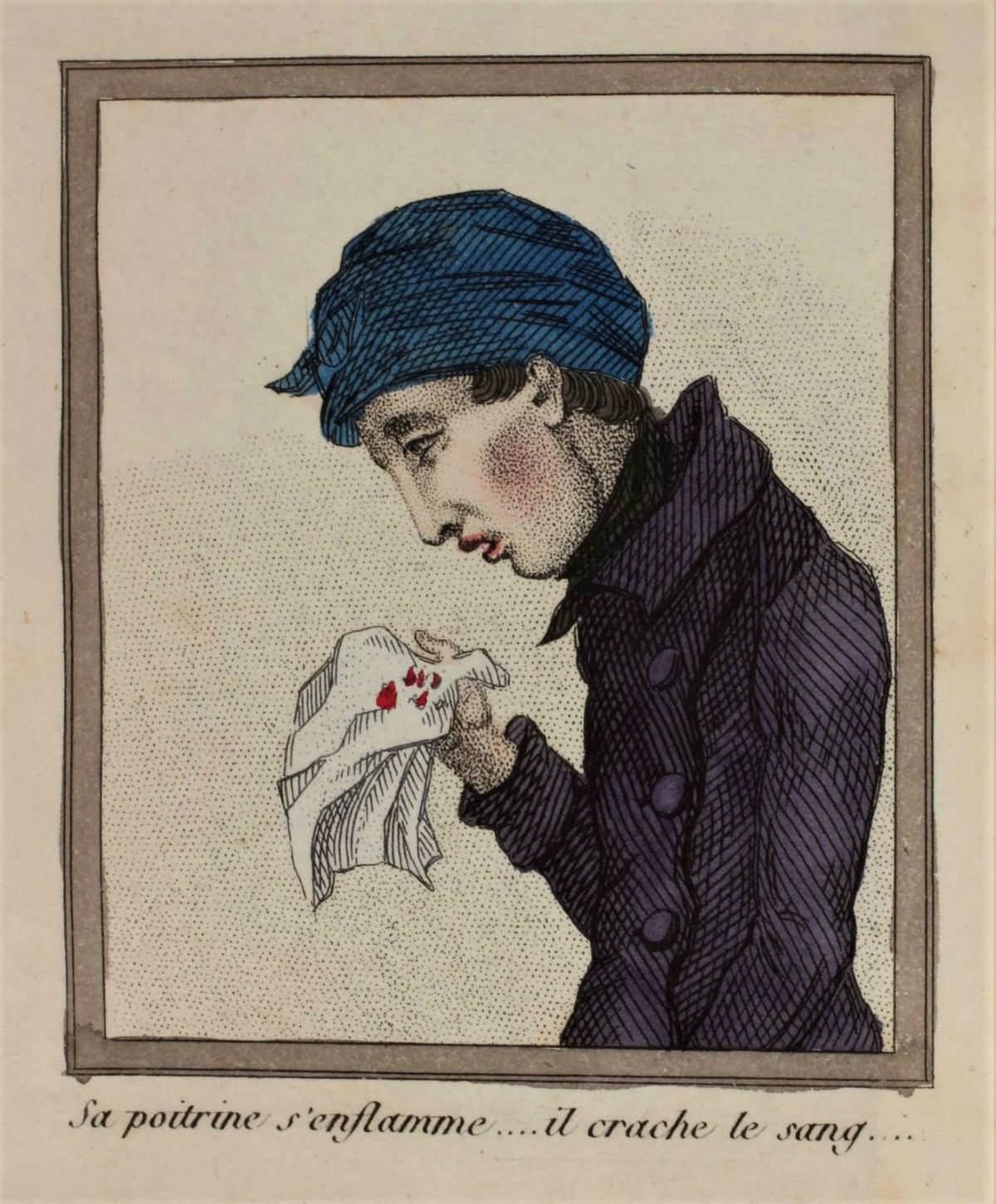
A bowed figure in a blue headscarf and heavy, dark coat leans inward, as if the weight of breath itself has become unbearable. In one hand he grips a white cloth, its clean folds punctured by fresh red spots, while a smear at the lips and a flushed cheek hint at fever, strain, and sudden pain. The simple border and spare background keep the eye fixed on the body’s quiet crisis: a moment when private illness becomes visible.
Beneath the scene, the French caption—“Sa poitrine s’enflamme… il crache le sang….”—echoes the post title’s grim turn of events, translating to a chest “aflame” and blood coughed up. That pairing of text and image reads like an illustrated cautionary tale, part medical warning and part human drama, rendered with careful linework and selective color. The artist’s choices—blue against near-monochrome, red used only where it shocks—make the symptom impossible to ignore.
Illness history often lives in statistics and hospital records, yet works like this preserve something more intimate: posture, pallor, and the fear of an unpredictable body. For readers drawn to historical art, medical history, and vintage illustration, the piece offers a stark window into how earlier audiences visualized respiratory suffering and blood-tinged coughs. It’s an “artwork” that doesn’t merely depict a patient; it narrates a turning point, suspended between diagnosis and dread.