Category: Civil Wars
Explore the human side of civil wars through authentic historical photographs. Witness the struggles, courage, and consequences of divided nations.
These images document key events and personal moments that shaped political and social transformations around the world.
-
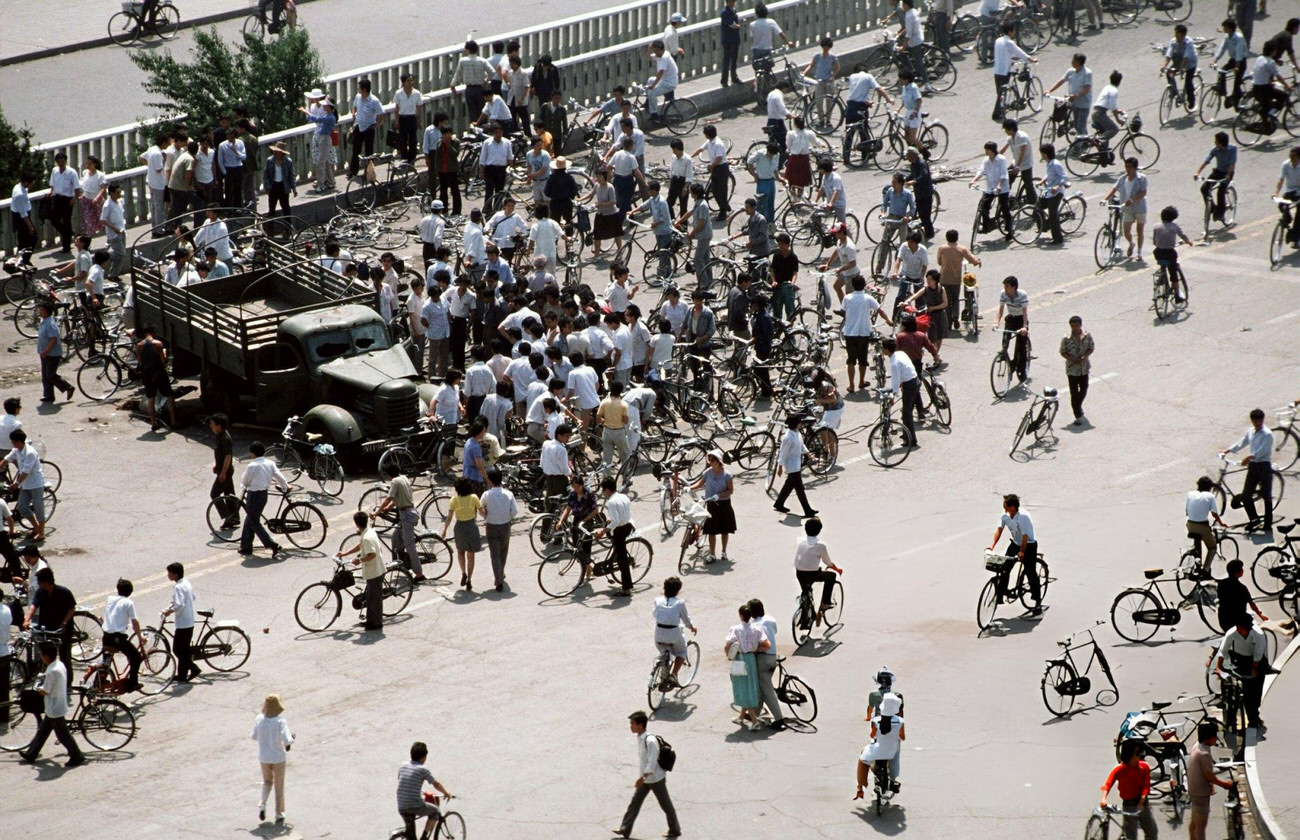
#53 Onlookers view Chinese Army trucks and vehicles that were damaged or destroyed, 1989.
From an elevated vantage point, a broad city roadway becomes an impromptu gathering site where onlookers cluster around Chinese Army trucks and vehicles left damaged or destroyed in 1989. A dark military truck sits amid scattered debris, while crowds press in close to inspect the wreckage. The scene’s scale is emphasized by the constant flow…
-
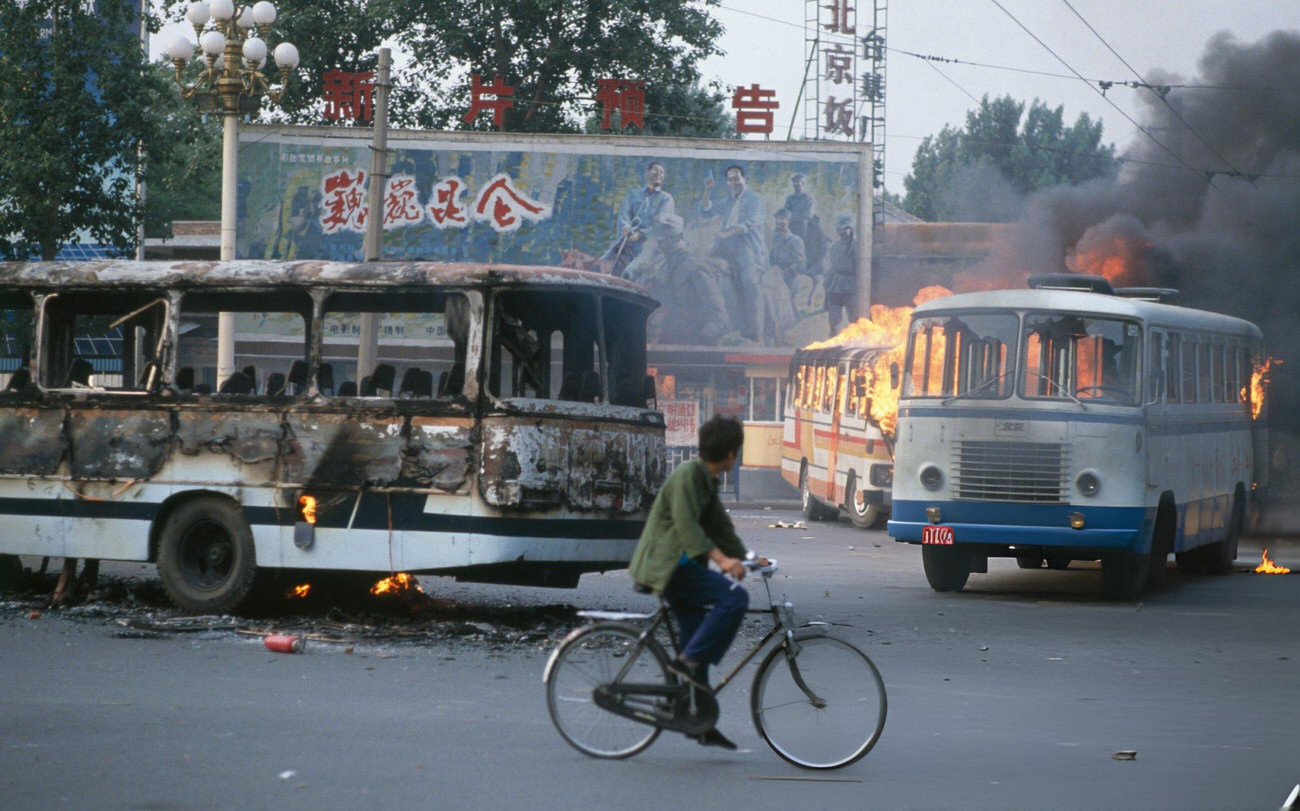
#69 The protest movement of students that started seven weeks ago in Tiananmen Square, 1989.
Smoke billows over a broad Beijing roadway where two buses burn, their windows blown out and frames scorched into dark skeletons. A lone cyclist rides past the wreckage, a small human figure set against the scale of fire and debris. In the distance, more flames lick at another vehicle, while a large wall mural and…
-
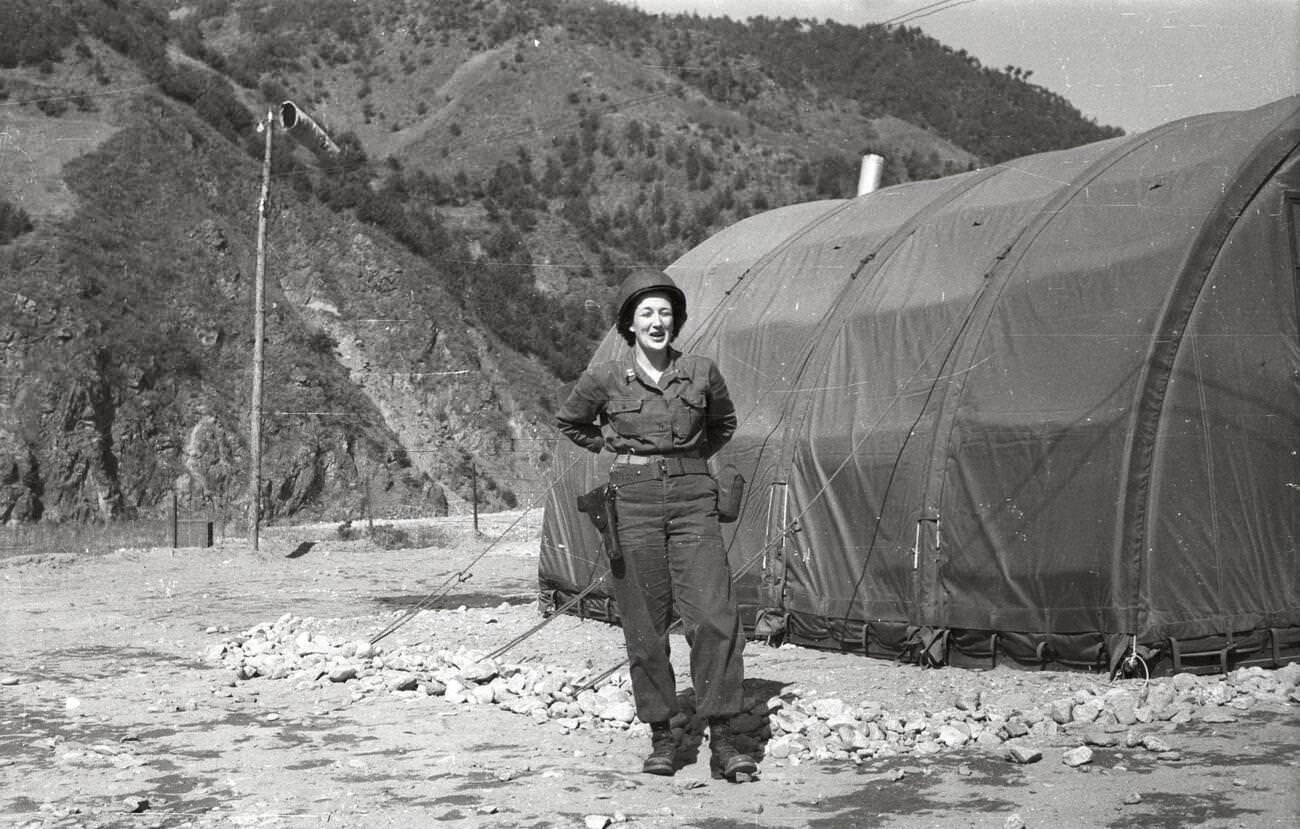
#10 A woman with the rank of captain outside a tent, Mobile Army Surgical Hospital (MASH), 1950s.
Framed by rugged hills and a line of canvas tents, a woman in U.S. Army uniform stands with the easy authority of an officer in the field. Her helmet, belted jacket, and practical boots speak to a working environment where rank mattered—but so did stamina—and the tent beside her hints at the constant movement and…
-

#26 The Korean War was a military conflict between the Republic of Korea, supported by the United Nations, and North Korea, supported by the People’s Republic of China, 1950s.
Dust and smoke hang over a broad urban street where soldiers move forward with rifles at the ready, dwarfed by leaning utility poles and a row of trees that still stand amid the chaos. Rubble and craters break up the roadway, and damaged buildings on the right edge suggest recent shelling or street fighting. Farther…
-
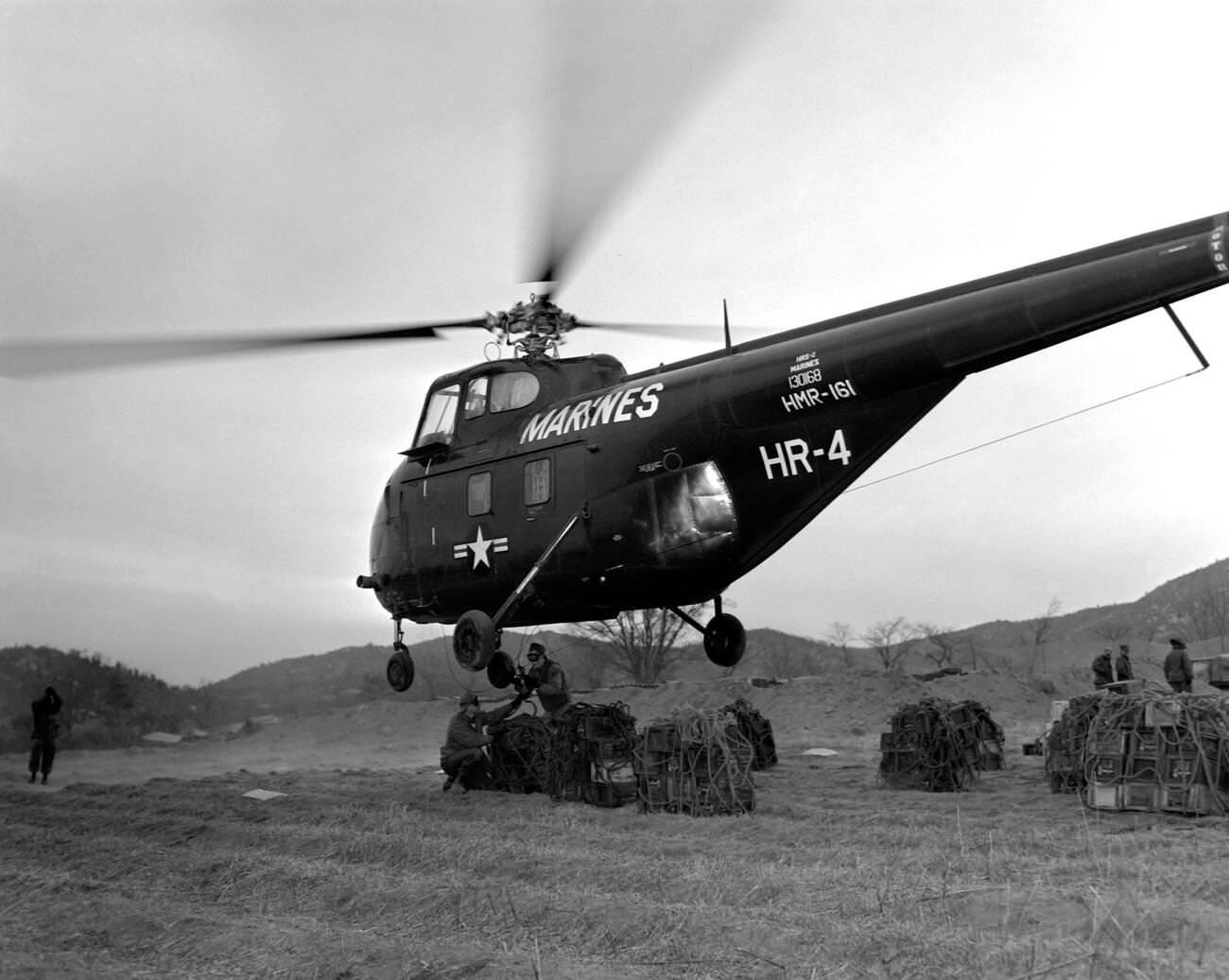
#42 Sikorsky HRS-2 helicopter, 1950s.
Rotor wash blurs the sky as a Sikorsky HRS-2 hovers just feet above a rough field, its “MARINES” markings and the designation “HR-4” standing out against the dark fuselage. Below, bundled cargo loads sit in netting and straps while a small group of Marines works close to the landing gear, guiding the aircraft in during…
-
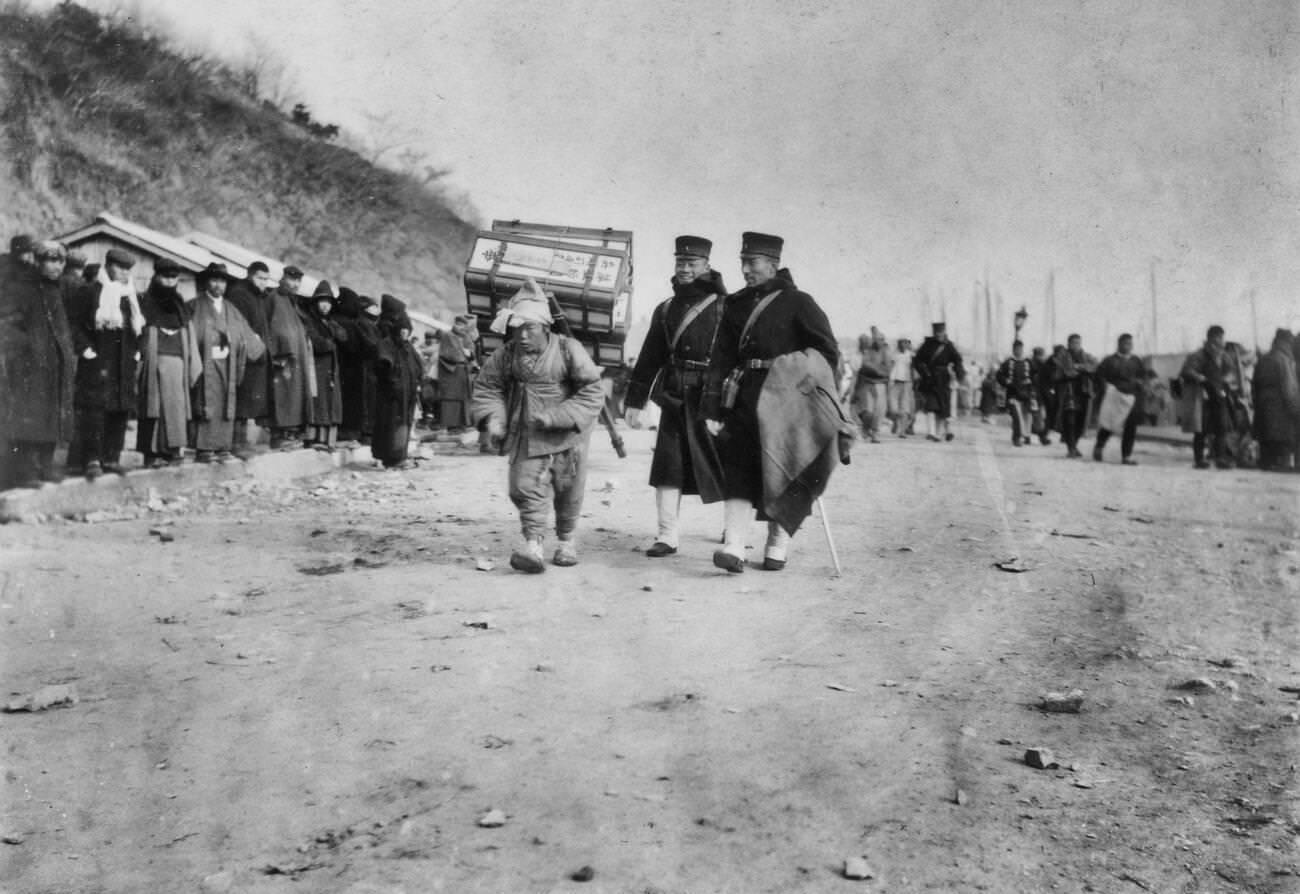
#58 A Korean coolie carrying medical supplies from shore to hospital, 1904.
Bent forward under a wooden crate lashed to a carrying frame, a Korean laborer trudges along a rough shoreline road, his winter clothing and headwrap suggesting cold air and hard ground. Behind him, a line of bundled onlookers hugs the edge of an embankment, their attention fixed on the procession moving through the open space.…
-
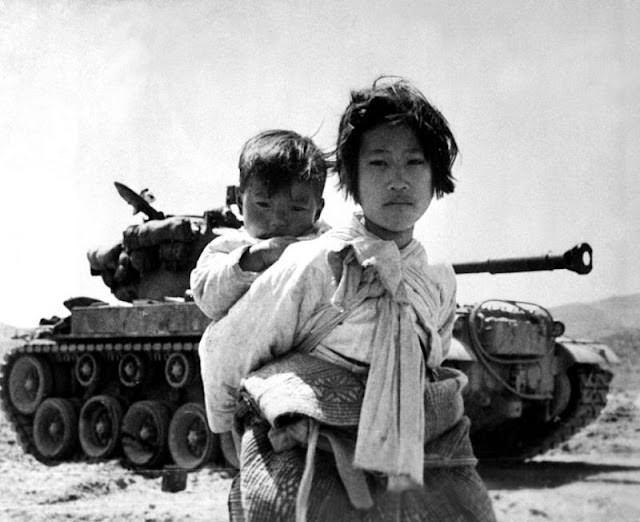
#74 Korean civilians pass an M-46 tank, 1950s.
Wind lifts the hair of a young Korean woman as she moves past the hulking silhouette of an M‑46 tank, a child riding on her back and another cradled close. The tank’s long gun barrel and tracked hull sit heavy against the open landscape, while the civilians’ bundled clothing and wrapped cloth ties suggest travel…
-
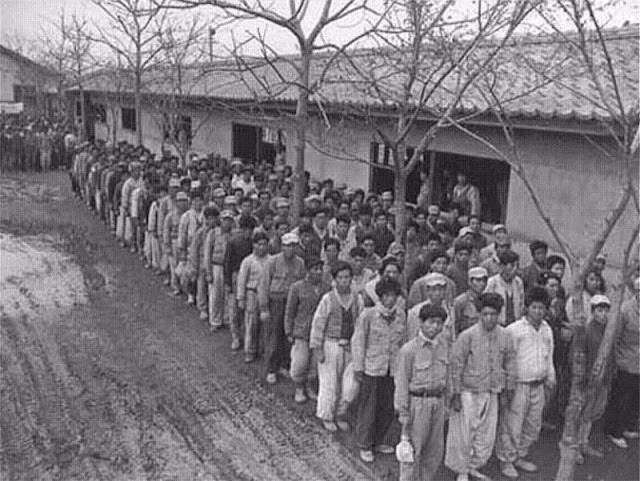
#90 National Defense Corps soldiers, 1951.
Along a muddy lane, a long line of National Defense Corps soldiers stretches beside low barracks-like buildings, forming a human column that seems to run the length of the compound. The men wear practical work uniforms and caps rather than parade dress, and many carry small containers or personal items as they wait their turn.…
-

#106 Kim Il-Sung ruled North Korea from its creation in 1948 until his death in 1994. Installed with the support of the Soviet Union, he led his country into the Korean War in an effort to unite the Korean peninsula under communist rule.
A uniformed leader stands at a microphone, mouth open mid-speech, projecting authority through posture as much as through words. The plain backdrop and tight framing push all attention onto the figure and the act of public address, a visual shorthand for the political culture taking shape in the early North Korean state. Details like the…
-
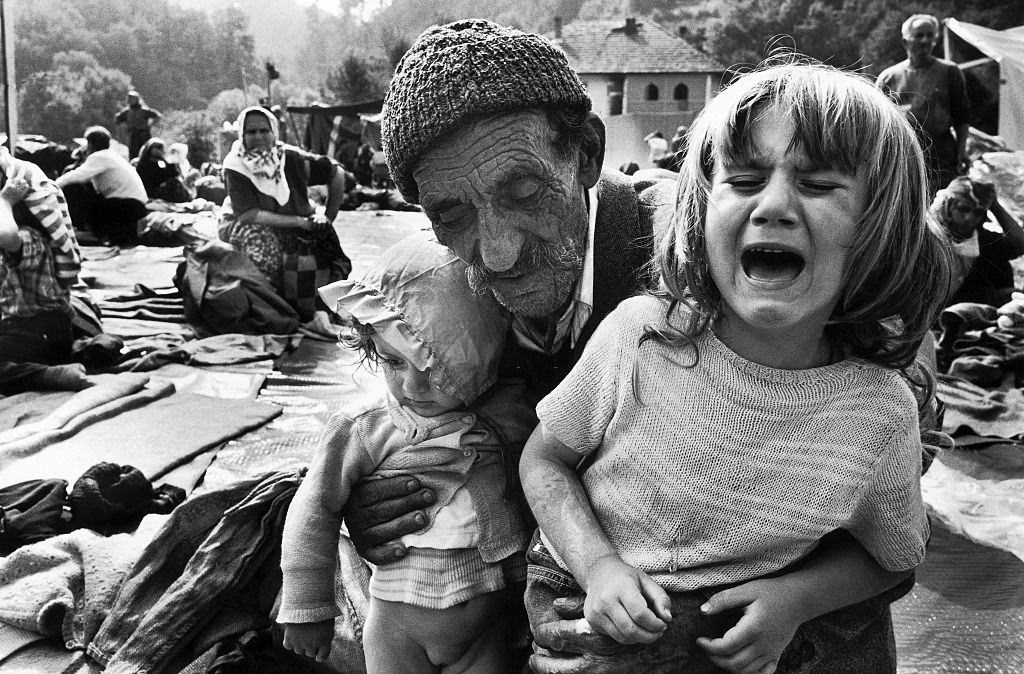
#6 A Muslim grandfather holds his exhausted, crying granddaughters on his lap after a long, frightening journey on foot to a United Nations refugee camp at Kladanj.
Weariness sits heavily on the grandfather’s face as he gathers his two granddaughters close, one limp with exhaustion and the other crying out in raw distress. His knit cap and weathered hands read like a lifetime of labor, now redirected into a single urgent task: keeping children safe. Around them, families rest on blankets and…