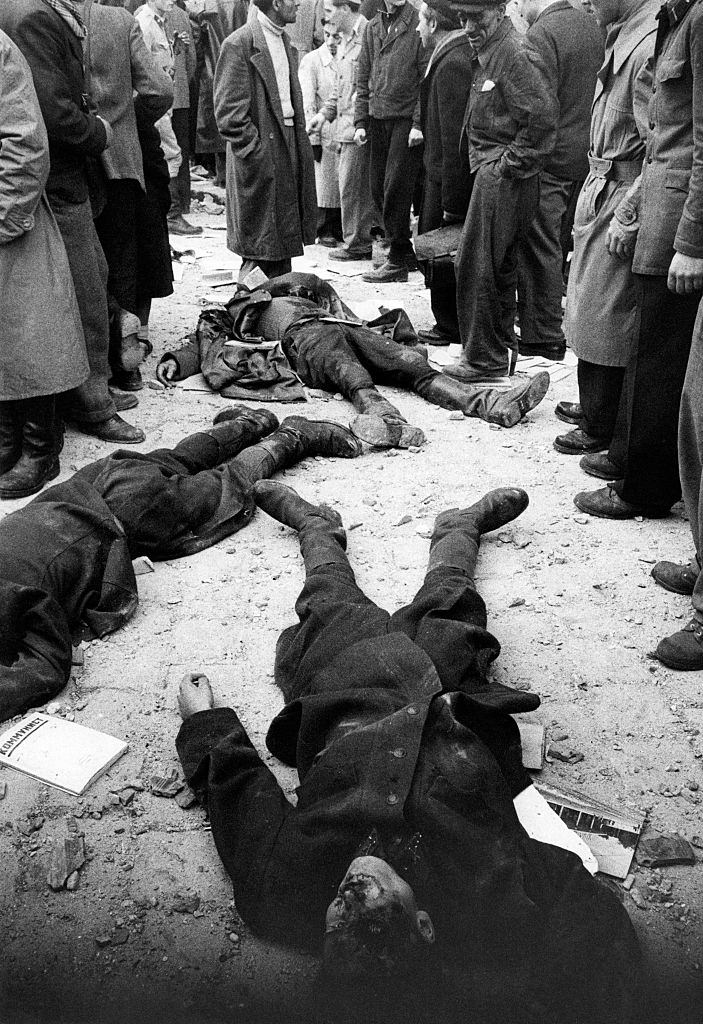
On a littered street, a ring of onlookers in heavy coats stands in tense silence as several bodies lie sprawled across the ground, boots askew and limbs slack. Papers and debris are scattered between shoes and shadows, hinting at a nearby building emptied by panic and violence. The crowd’s posture—hands in pockets, heads angled downward—suggests not curiosity alone, but the wary aftermath of a battle that has just moved on.
The title situates the scene after the fight for the headquarters of the Communist Party, identifying the dead as Hungarian secret police agents (AVH), a force widely associated with political repression. Without needing to show the combat itself, the photograph conveys the collapse of authority in a single frame: uniforms and civilian clothing mingle at the edges, and the boundary between state power and the street has been broken. In the context of civil conflict, moments like this become public reckoning, where anger, relief, and fear can occupy the same breath.
Such images are difficult to linger over, yet they remain essential records for anyone researching the Hungarian uprising, Cold War-era crackdowns, or the broader history of secret police in Eastern Europe. The photographer captures the human cost and the social atmosphere of immediate post-battle reality—bystanders compelled to witness, and the ground itself turned into evidence. For readers seeking historical photo documentation of revolutionary violence and its aftermath, this stark scene offers an unfiltered glimpse into how quickly political struggles become personal tragedy.