Category: Colorization
See history come to life with colorized photographs of the past. From wars to daily life, these restored images bridge time with emotion and realism.
Each colorized photo revives forgotten stories and gives a fresh perspective on iconic historical moments.
-

#24 A tank crew in front of an M-4 tank at Fort Knox, Kentucky, 1942.
Under a bright Kentucky sky, a trio of tankers stands close to the broad side of an M‑4 tank, their coveralls creased and dusted from the day’s work. Each man grips a helmet as if pausing between duties, while another crewman perches atop the turret, lending the scene a relaxed, candid feel despite the machine’s…
-
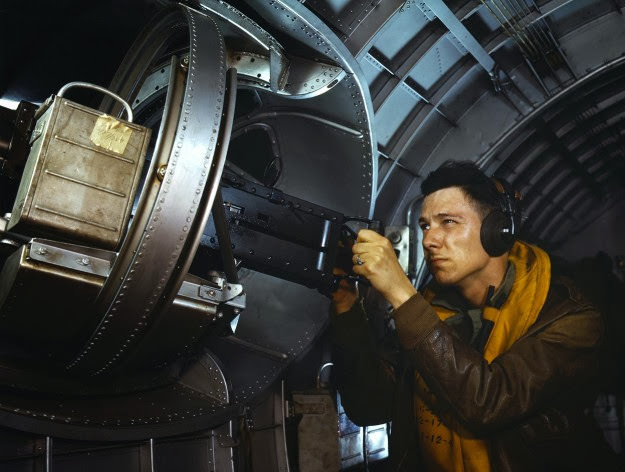
#40 A non-commissioned officer works on a YB-17 bomber machine gun, 1942.
Inside the curved metal ribs of a YB-17 bomber, a non-commissioned officer leans into his work with the focus of someone who knows that small details can decide big outcomes. The colorization brings out the cold sheen of riveted aluminum and the muted warmth of his flight gear, turning a utilitarian interior into a lived-in…
-
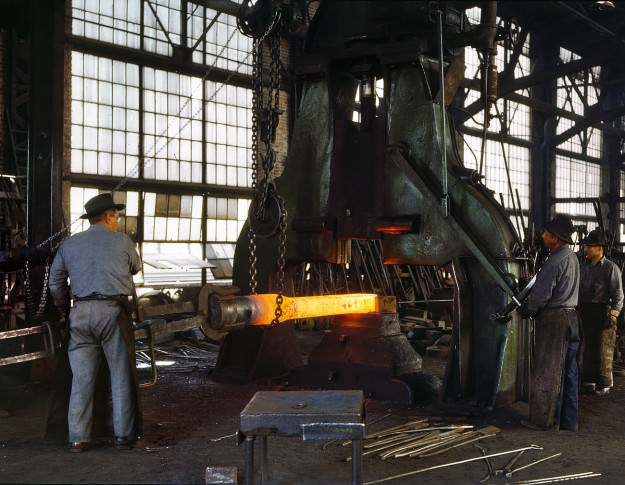
#11 March 1943. “Santa Fe R.R. shops, Albuquerque. Hammering out a drawbar on the steam drop hammer in the blacksmith shop.” 4×5 Kodachrome transparency by Jack Delano for the Office of War Information.
Inside the Santa Fe Railroad shops in Albuquerque, the blacksmith shop becomes a furnace-lit stage where a drawbar—heated to a vivid orange—waits under the looming mass of a steam drop hammer. Chains hang from overhead rigging, scattered tools lie across the dark floor, and tall factory windows pour in hard daylight that catches the haze…
-
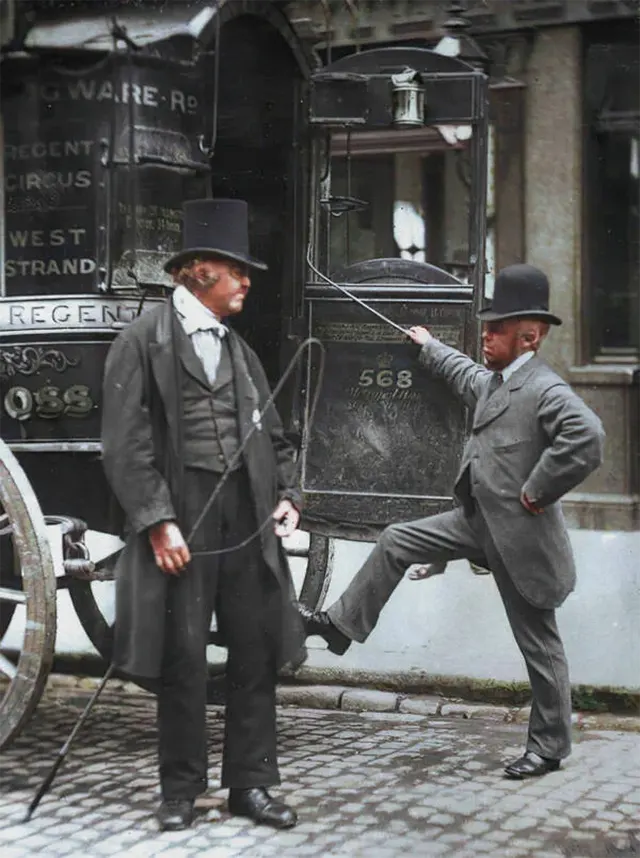
#4 Omnibuses were a popular mode of transportation in Victorian London, 1890s.
Along a cobbled London street, a horse-drawn omnibus pauses while its crew holds the foreground: a stoutly dressed driver in a tall hat and a shorter man posed with one foot up, whip in hand, as if caught between work and performance. The vehicle’s dark panels, lantern, and metal fittings speak to the practical engineering…
-
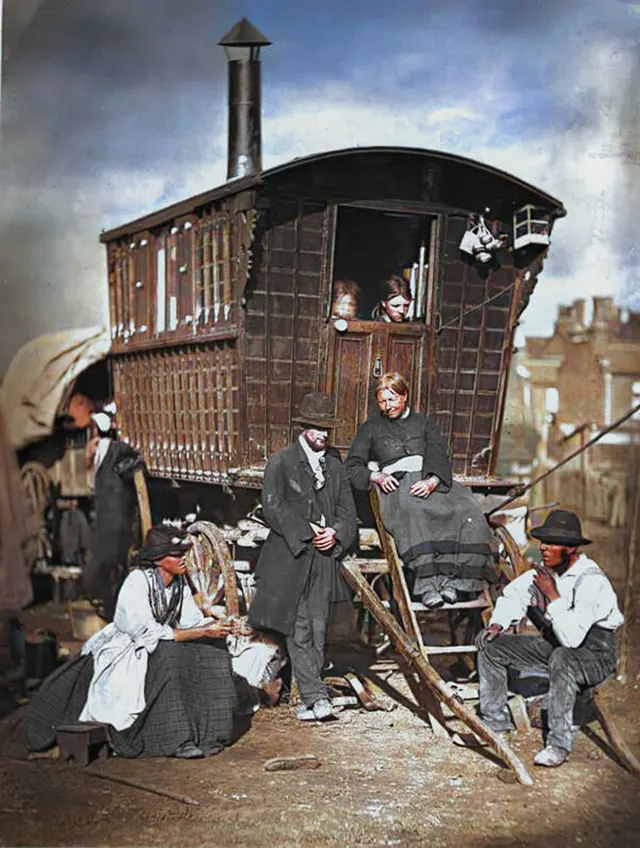
#20 A caravan at an encampment near Latimer Road, Notting Hill, 1890s.
Set beside the rough ground of an encampment near Latimer Road, Notting Hill, a dark wooden caravan becomes the scene’s anchor, its curved roof and tall stovepipe chimney rising against a washed sky. The colorization brings out the worn timbers, the metal fittings, and the practical shape of a home built to move, while blurred…
-

#36 A chimney sweep and his assistant, 1890s.
Soot and weather seem to cling to the chimney sweep’s face as he pauses against a rough exterior wall, his wide-brimmed hat and heavy coat suggesting a trade practiced in all seasons. A bundled set of long brushes and rods leans beside him like an extra silhouette, the tools of a working life displayed as…
-

#11 The Saint Valentine’s Day Massacre, in which seven members of the North Side Gang were trapped in a garage, lined up against the wall, and shot to death by members of Al Capone’s rival gang during a power struggle for control of Chicago, 1929.
Muted color brings a brutal immediacy to the garage floor where bodies lie in heavy coats and suits, hats still on, as if the moment were interrupted mid-breath. Against the pale brick wall, dark stains spread across the concrete in stark contrast to the tidy lines of clothing and the hard geometry of the room.…
-

#27 A dead man at the foot of a staircase in a French crime scene. 1912.
At the foot of a narrow staircase, a body lies in a cramped interior where every detail feels uncomfortably close: patterned rugs, tight walls, and the sharp angle of the steps that frame the scene. The colorization draws the eye to the stark contrast between dark clothing and pale linens, while the confined space suggests…
-
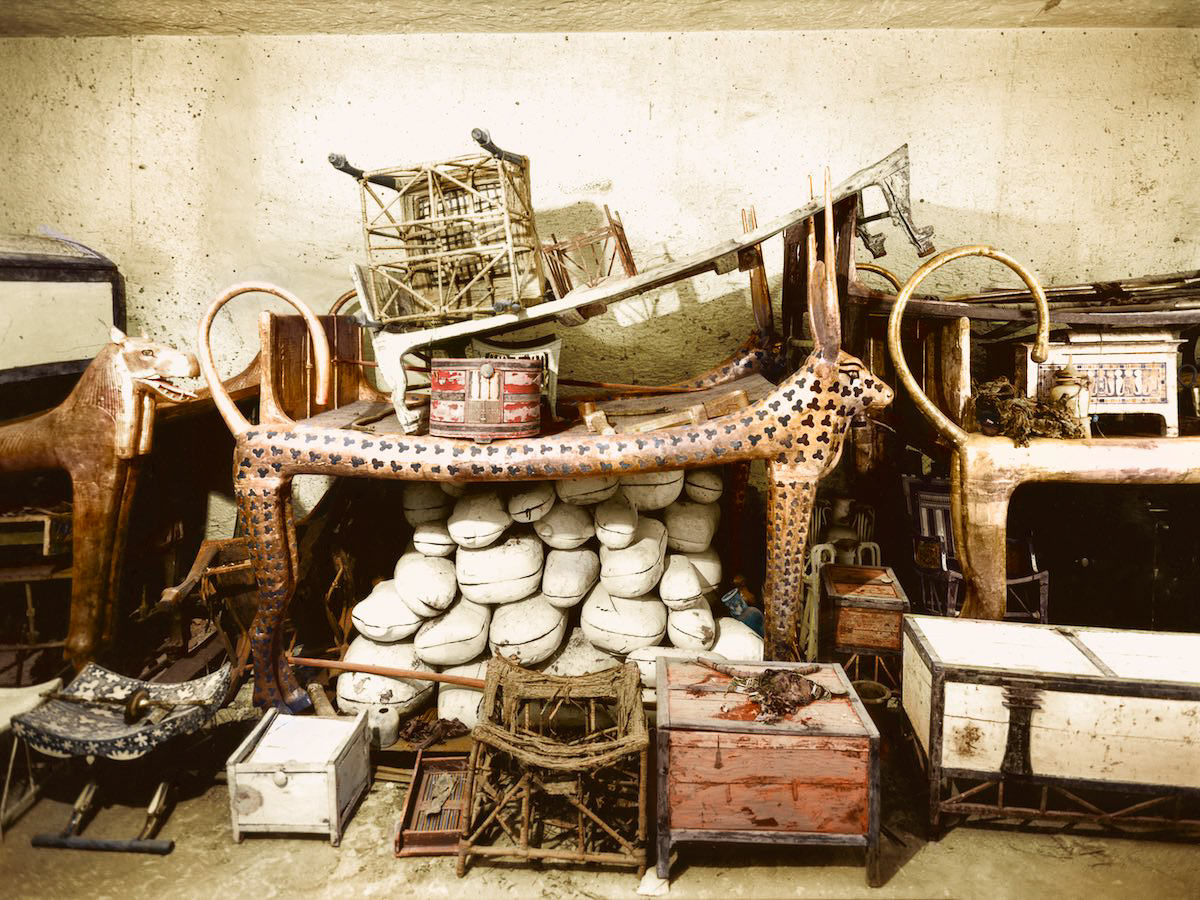
#2 Objects, including the cow-headed couch (Carter no. 73) and boxes containing joints of meat (Carter nos. 62a to 62vv) piled up against the west wall of the Antechamber. Tutankhamun’s Tomb, December 1925
Along the west wall of the Antechamber, the burial goods from Tutankhamun’s Tomb appear less like a tidy “treasure” and more like a lived-in storeroom, stacked in urgent layers. The cow-headed couch (Carter no. 73) dominates the scene with its curved rails and animal-headed terminals, its painted surface still holding onto pattern and sheen even…
-
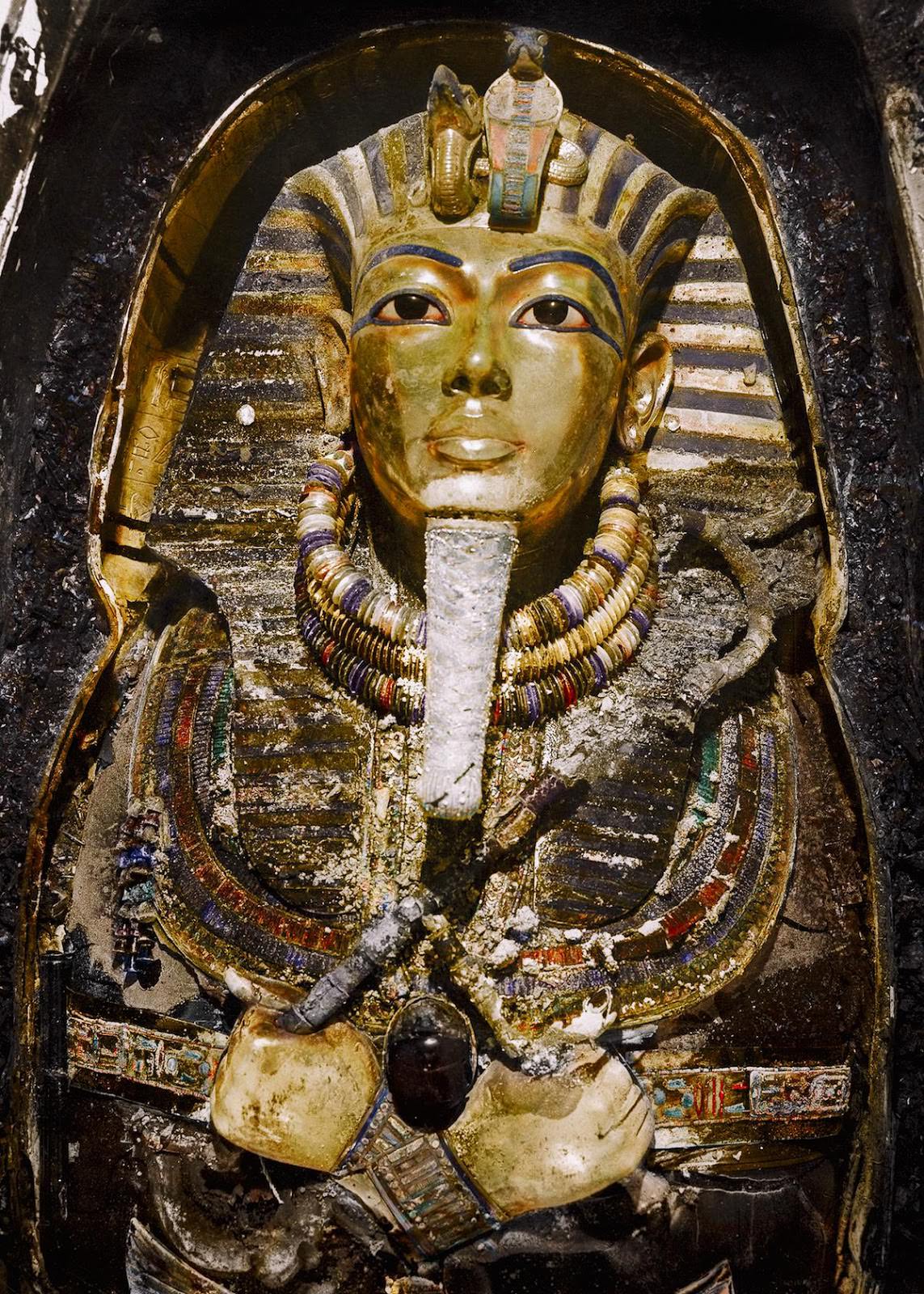
#18 The gold mask (Carter no. 256a) in situ on the mummy of the King, still inside the third (innermost) solid gold coffin (Carter no. 255). Tutankhamun’s Tomb, 30th October 1925
Gleaming from the darkness of the burial chamber, the gold mask (Carter no. 256a) rests exactly where it was found—on the mummy of the King, still enclosed within the third, innermost solid gold coffin (Carter no. 255). The colorization draws the eye to the serene face, the striped nemes headdress, and the crisp inlays that…