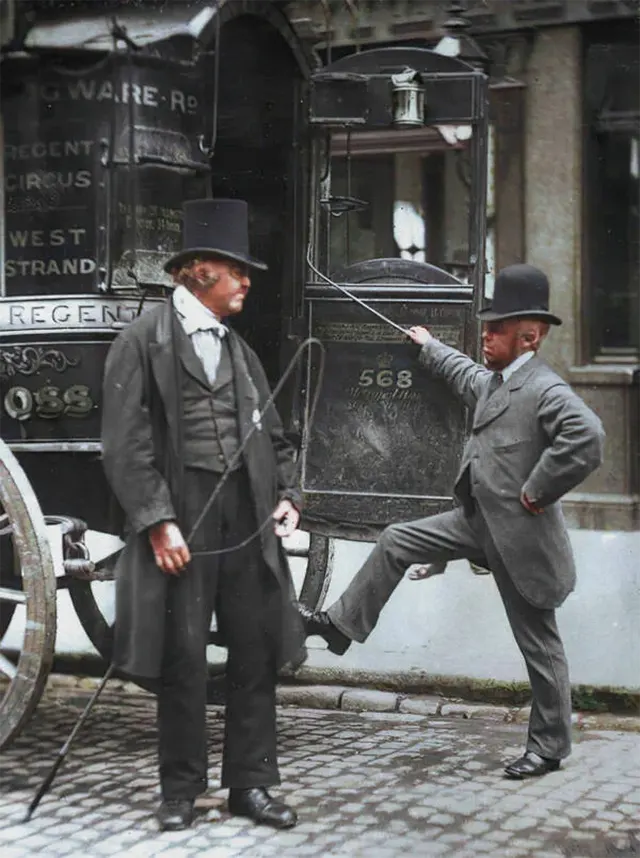
Along a cobbled London street, a horse-drawn omnibus pauses while its crew holds the foreground: a stoutly dressed driver in a tall hat and a shorter man posed with one foot up, whip in hand, as if caught between work and performance. The vehicle’s dark panels, lantern, and metal fittings speak to the practical engineering of Victorian public transport, while the colorization brings out textures—wool coats, polished leather shoes, and the worn sheen of a working carriage—that black-and-white often flattens.
Behind them, painted route lettering hints at the omnibus network that stitched together the city’s everyday journeys, carrying clerks, shoppers, and laborers through busy districts. The people may be anonymous, but their posture and attire tell a familiar story of late-19th-century London: discipline, routine, and a certain pride in uniformed roles that kept traffic moving long before motor buses dominated the roads.
Seen today, the scene reads like a small street-side theater of Victorian London transportation in the 1890s, with the omnibus serving as both workplace and public stage. For readers interested in historical London, early mass transit, or the social life of the streets, this colorized image offers a vivid reminder that the city’s mobility once depended on horses, timetables painted by hand, and the men who managed them in all weathers.