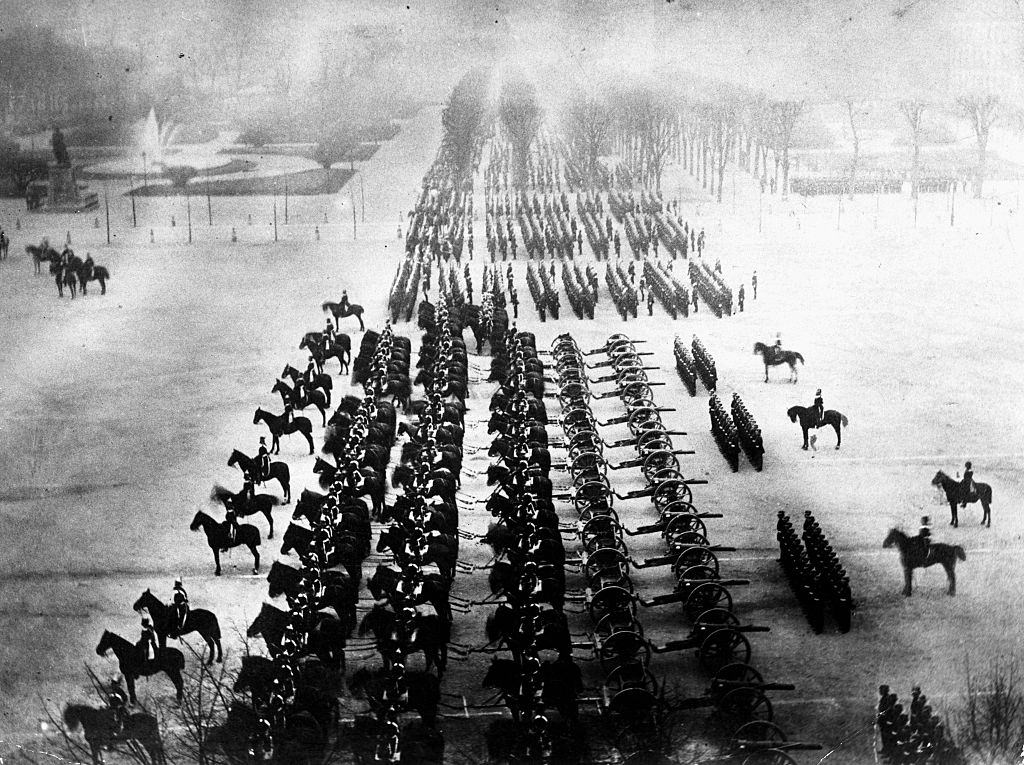
Winter light washes over the Champs-Élysées as long ranks of Prussian troops advance in measured formation, their lines receding toward the hazy distance of Paris. From this elevated viewpoint, the geometry of occupation becomes unmistakable: infantry blocks, mounted riders spaced like sentries, and artillery pieces aligned wheel-to-wheel. The broad avenue, normally a stage for Parisian leisure, is rendered stark and almost silent beneath a pale, frosty ground.
Order and spectacle mingle in the details, where cavalry elements flank the marching columns and the guns follow with deliberate inevitability. The sheer scale of the parade reads less like celebration than demonstration—an unmistakable assertion of control after the city’s takeover during the Franco-Prussian War. Even without close-up faces, the disciplined spacing and rigid cadence convey the authority of an army making itself seen.
For readers tracing the aftermath of nineteenth-century European conflict, this historic Paris photograph offers a vivid entry point into January 1871 and the uneasy pause between battle and political reckoning. The image underscores how warfare reaches beyond the front lines, turning iconic urban spaces into theaters of power. Seen today, the parade on the Champs-Élysées stands as a reminder that capitulation and occupation leave their own kind of imprint on a city’s memory.