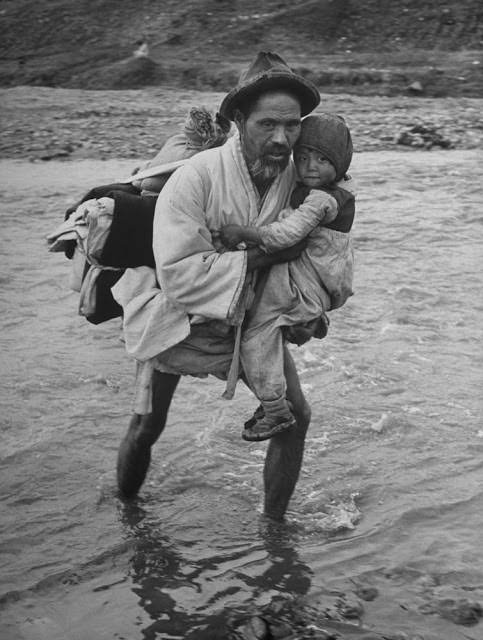
A man wades through a cold, fast-moving river with a small child clutched tightly against his chest, their bodies angled into the current as if every step must be fought for. A bundled pack rides on his back, suggesting a life reduced to what can be carried, while the child’s hood and stiff posture hint at fear, exhaustion, and exposure. Behind them, the rocky bank and barren slopes offer no comfort—only the stark geography of flight.
The title, “Refugees cross into South Korea, 1951,” places this moment within the upheaval of the Korean War, when families were uprooted and borders became lifelines. With no vehicles, bridges, or formal passage in sight, the crossing itself becomes the story: survival measured in yards of water and the strength to keep moving. The scene resonates with the broader history of civil wars and conflict-driven migration, where ordinary people are forced into extraordinary decisions.
For readers searching for Korean War refugee history, civilian displacement, or 1951 wartime photography, this image stands as a plainspoken record of what mass movements look like on the ground. It is not a battlefield, yet it carries the war’s imprint in every soaked trouser leg and tightened grip. Even without names or a marked location, the photograph preserves a universal truth of refuge—danger behind, uncertainty ahead, and the fragile weight of someone you cannot afford to drop.