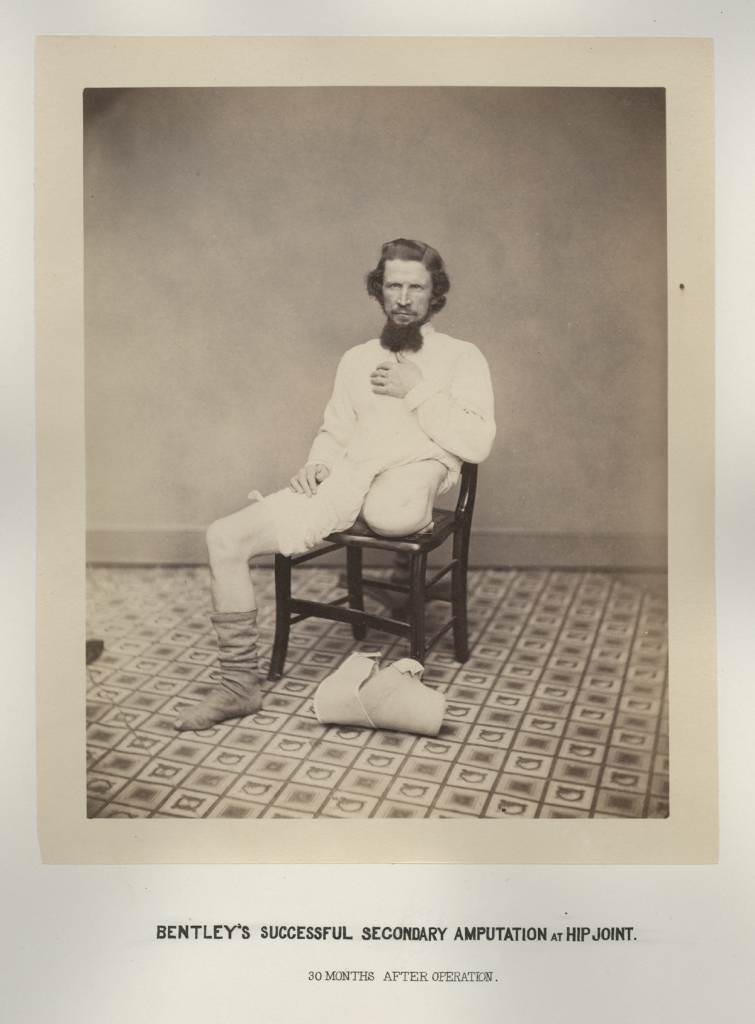
Private George W. Lemon sits for the camera in a plain studio setting, posed on a simple wooden chair above a patterned floor that makes the stillness feel almost measured. His clothing is practical and light, his expression steady, and his posture carefully arranged to present his body as evidence as much as portrait. The composition directs attention to the physical cost of the War of the Rebellion, while insisting on the subject’s presence and dignity.
Drawn from George A. Otis’s 1867 volume of drawings, photographs, and lithographs documenting seven survivors of hip-joint amputation, the image belongs to a medical and military record-keeping project as well as to the visual culture of the Civil War era. The captioning emphasizes outcome and timeframe, reflecting how surgeons and compilers framed these men as “successful cases” in an age when battlefield injuries forced rapid developments in wartime medicine. What looks like a quiet sitting room scene is, in context, a clinical statement about survival, trauma, and the limits of 19th-century treatment.
For readers searching Civil War history, amputation photography, or the work of the Army Medical Museum-era publications, this post highlights how photography served both documentation and persuasion. The spare backdrop and direct gaze underscore the human story behind medical statistics, turning an abstract “case” into a person who endured. Seen today, the photograph invites reflection on disability, recovery, and the long aftermath of war that continued well beyond the battlefield.