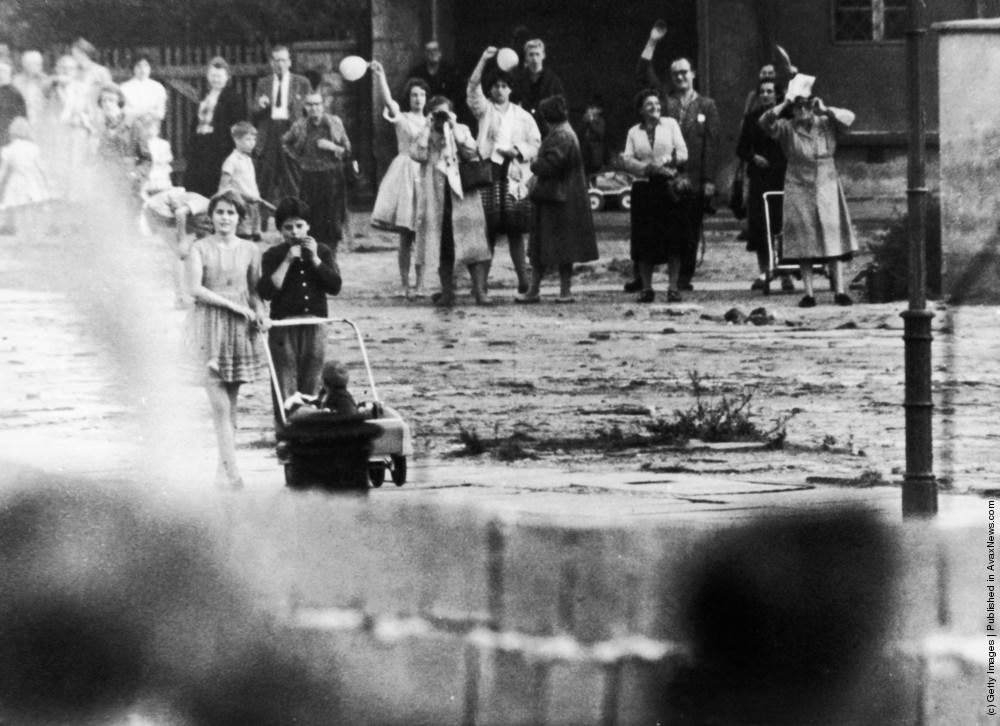
Across a raw stretch of ground, a small crowd gathers at the edge of a new boundary, lifting hands in greeting and clutching makeshift signals to be seen from the other side. In the foreground a woman stands beside a pram while a boy watches, and behind them adults wave, smile, and strain forward, as if a few extra inches might bridge what politics has split. The barrier itself sits low in the frame, blurred yet unmistakable—an intrusion into ordinary life that turns a familiar street into a divided world.
The title’s reference to the Berlin Wall evokes a moment when neighbours became “foreign” overnight, their relationships reduced to gestures across concrete and patrol space. What feels most striking is the mixture of everyday domesticity and sudden separation: children, coats, handbags, and hurried hellos set against the hard line of Cold War confrontation. Rather than soldiers and speeches, the scene centers on families and friends, suggesting how grand ideological conflict was experienced as a personal rupture.
For readers interested in Berlin Wall history and Cold War Germany, this photograph offers a powerful reminder that division was not abstract—it lived in faces, bodies, and the awkward choreography of waving across an obstacle. The existing tag of “Civil Wars” resonates here in a broader sense, capturing that bitter, internal fracture where a single city could contain two realities. Seen today, the image asks what it costs when borders are drawn through communities, and how human connection persists even when it must travel by hand signal and distant eye contact.