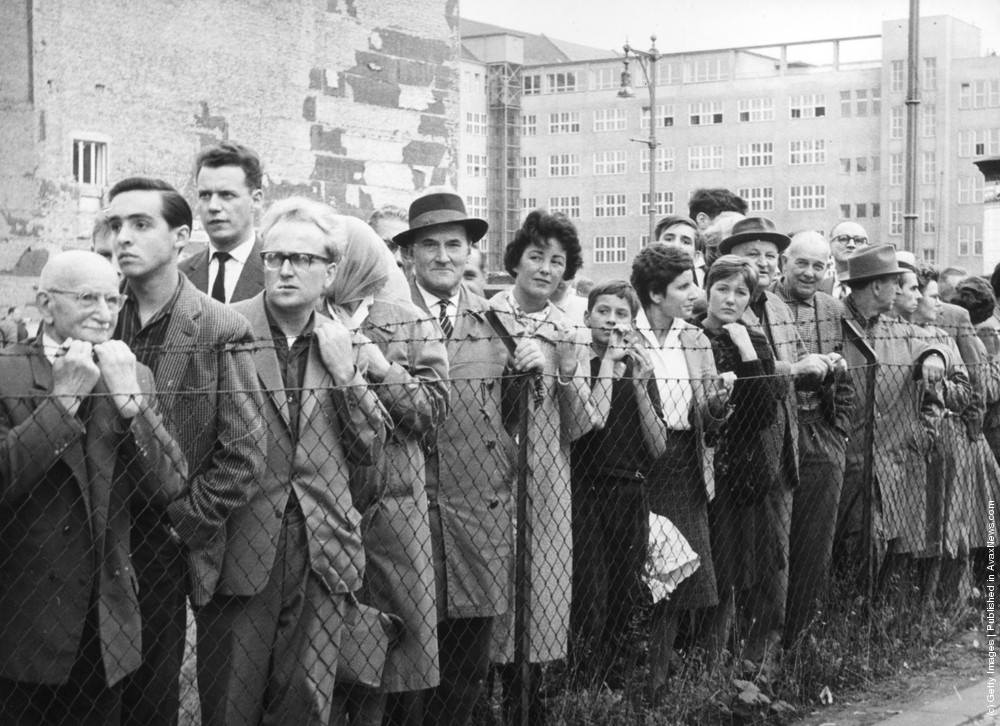
Along a makeshift boundary of wire and fencing, a dense line of West Germans presses forward, faces tilted toward the unseen crossing point where loved ones might appear. Coats are buttoned against the chill, hats sit low, and hands grip the mesh as if contact itself could bridge the divide. Behind them, battered walls and stark apartment blocks frame a city still carrying the scars of war and the weight of a new political order.
The title’s promise—“a day when the Berlin Wall is open”—hangs over the scene like a held breath, turning an ordinary street edge into a stage for reunion. People of different ages stand shoulder to shoulder, some watchful and tense, others visibly hopeful, each expression suggesting how personal the Cold War could become in divided Berlin. Even without seeing the arriving side, the crowd’s collective attention tells the story: separation has been normalized, and any opening, however brief, becomes a rare chance to restore what borders interrupt.
For readers searching the history of the Berlin Wall, West Germany, and East–West crossings, this photograph offers an intimate view of waiting as a political act. It captures the human geography of division—neighbors and relatives kept apart, then drawn back together by rumor, permission, or sudden change at the checkpoint. In the broader narrative of civil conflict and ideological confrontation, the image reminds us that the era’s hardest lines were not only drawn on maps, but felt in the quiet, anxious minutes before a familiar face comes into view.