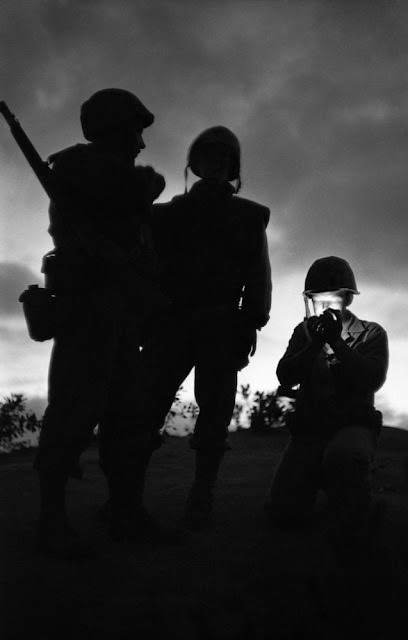
Against a brooding sky, three soldiers appear mostly in silhouette, their helmets and gear forming a stark outline that immediately places the viewer in the tense atmosphere suggested by the title, “Three soldiers, 1952.” One figure stands to the left with a rifle slung over the shoulder, another stands near center, and a third crouches lower, the pose hinting at vigilance and the practical realities of moving and communicating under pressure. The heavy contrast and low angle make the scene feel larger than life, as if the horizon itself is part of the story.
The crouching soldier draws the eye because a small burst of reflected light catches the face and hands, suggesting close attention to a device or instrument—possibly a camera or field gear—while the others keep watch. Even without visible insignia or a readable backdrop, the uniforms, helmets, and posture evoke mid‑20th‑century military life and the uncertainty that often surrounds civil conflict. The composition balances stillness with implied motion, as though the next command could come at any moment.
For readers interested in civil wars and the lived experience of soldiers, this 1952 photograph offers an evocative, human-scale glimpse into service beyond the headlines. Its minimal details invite careful looking: the slope of the ground, the spacing between the men, the way equipment sits against the body, and how light turns ordinary moments into memory. Use it as a starting point for exploring the era’s military history, wartime photography, and the enduring visual language of conflict and camaraderie.