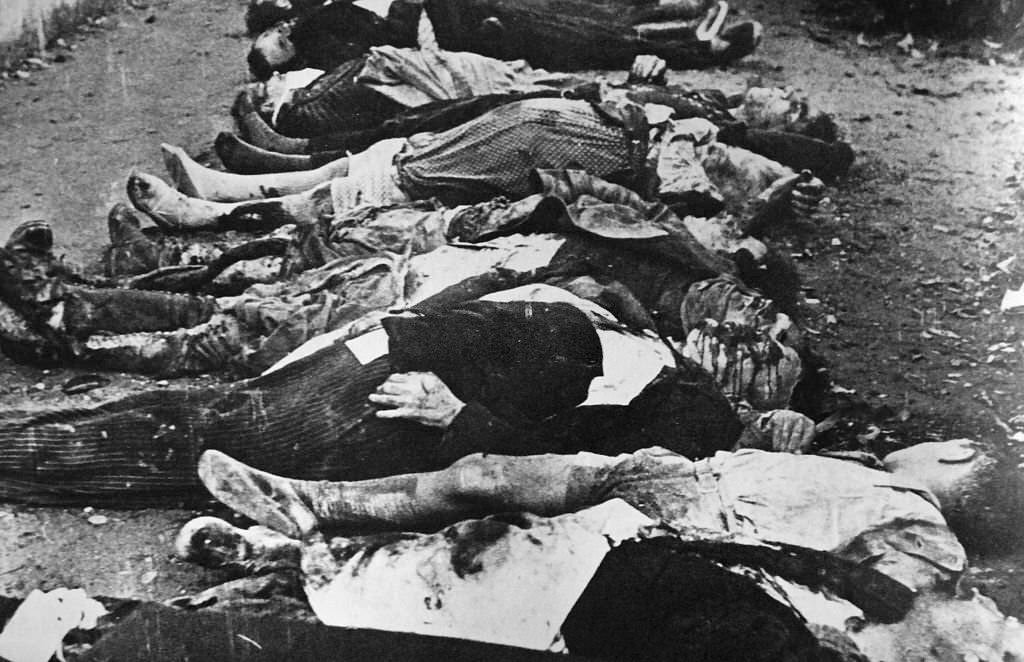
Bodies lie in a row along a hard street surface, clothing torn and dusted with debris, the stillness made more brutal by the casual scatter of fragments around them. The frame offers no skyline, no aircraft, no firefight—only the human aftermath, crowded into the foreground where faces and hands become the most haunting details. In the context of civil wars, that absence of action is its own testimony: violence has already passed through, leaving the city to count the cost.
Lleida, named in the post title, anchors the scene to the Spanish Civil War and to the Condor Legion’s role in air raids that turned urban spaces into targets. The photograph’s composition forces the eye to linger on civilians and everyday attire rather than uniforms, underscoring how bombing blurred the boundary between front lines and home streets. As a historical source, it reflects the era’s grim arithmetic—air power measured not only in tactical gains, but in lives abruptly ended on familiar pavement.
For readers searching the history of the Condor Legion attack on Lleida, this image serves as a stark entry point into discussions of aerial bombardment, propaganda, and the widening reach of modern warfare. Its documentary quality makes it valuable for understanding how the Spanish Civil War foreshadowed the mass violence of later conflicts, when towns could be punished from above with little warning. The photograph does not explain itself; instead, it demands that we supply the context, remember the victims, and confront what “civil wars” look like when the violence arrives from the sky.