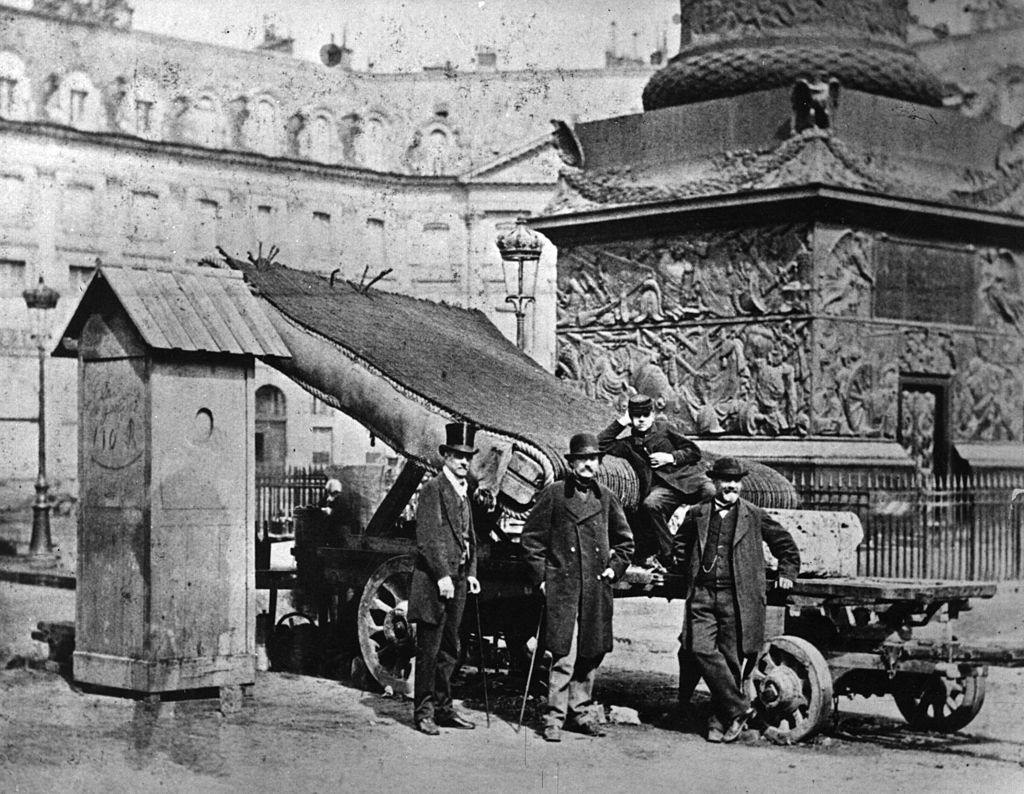
In the heart of Place Vendôme, a curious contraption sits beneath the looming monument: a wheeled platform fitted with a slanted shield, part vehicle and part fortification. A small guard box stands nearby, while several men in dark coats and hats pose with the easy stillness of people accustomed to being watched—and to watching. The scene feels improvisational, as if the calm geometry of Parisian stone has been interrupted by an urgent, makeshift answer to danger.
Mobile barricades like this speak to a city learning to defend its streets in real time during the Franco-Prussian War, when movement and rapid response could matter as much as masonry. Instead of the classic piled paving stones and overturned carts, here the barricade becomes portable, blending engineering with street-level necessity. The heavy wheels, exposed framework, and angled plating hint at an attempt to protect men while allowing them to shift position quickly across open squares and broad avenues.
Place Vendôme is usually associated with elegance and order, yet this photograph preserves a moment when civil conflict and wartime pressure reshaped public space. The monument’s sculpted base, the iron railings, and the uniform façades form a refined backdrop for a defensive tool that looks almost experimental. For readers interested in Paris history, urban warfare, and the Franco-Prussian War, the image offers a stark reminder that even the most celebrated landmarks can become stages for improvisation, anxiety, and resilience.