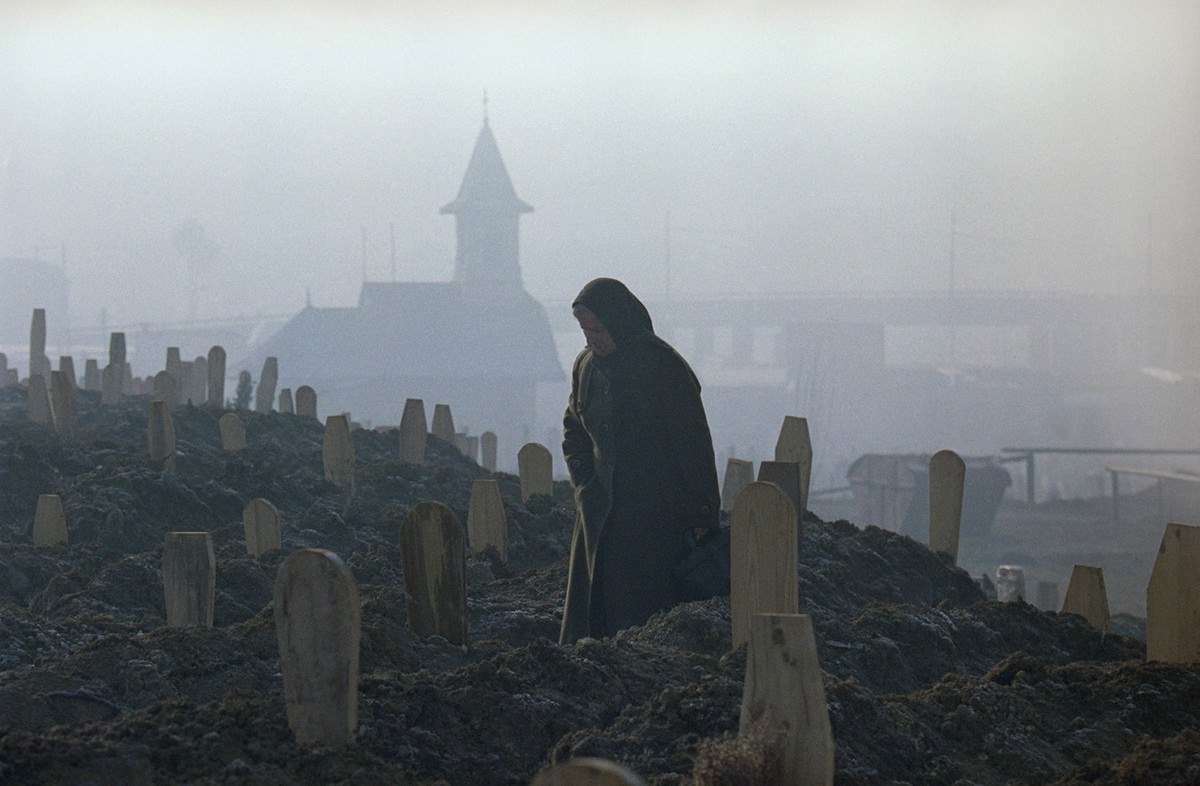
Morning fog hangs low over a Sarajevo cemetery, turning the skyline into soft silhouettes while the ground in the foreground looks newly heaped and uneven. Dozens of simple wooden markers rise from the fresh earth, some leaning slightly, their pale surfaces catching the thin winter light. At the center, a lone woman in a dark coat and headscarf stands among the graves, her posture heavy with the private weight of loss.
January 17, 1993 falls in the midst of the Bosnian War, when Sarajevo’s civil conflict brought daily danger and a relentless toll on civilians. The image’s quiet details—muddy mounds, hurried-looking markers, the chill of early morning—suggest a burial landscape shaped by urgency rather than ceremony. Against the distant outline of a church-like tower and the faint suggestion of urban infrastructure, grief is framed not as an isolated moment but as part of a city’s strained routine.
What makes the photograph enduring is its contrast between stillness and catastrophe: a solitary mourner set against rows that imply many more stories than any caption can hold. For readers searching for Sarajevo 1993, Bosnian War cemetery scenes, or the human cost of civil wars, this frame offers a stark, intimate record of how conflict reshapes ordinary spaces. It asks us to linger on the aftermath—on remembrance, on survival, and on the quiet acts of mourning that continue even when a city is under siege.