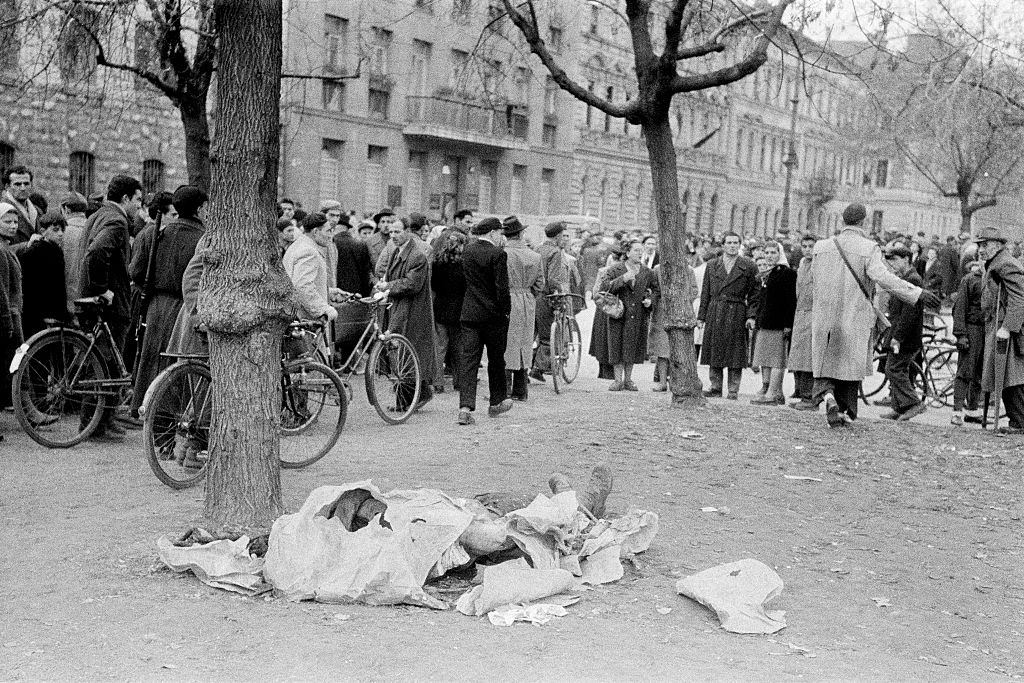
On a broad Budapest street in 1956, the routines of city life buckle under the weight of violence. A body lies on the pavement in the foreground, partly covered with torn fabric and paper, while a ring of onlookers gathers at a cautious distance. Bicycles rest against legs and curbs, bare trees frame the scene, and the surrounding buildings stand indifferent—urban backdrops that make the sudden intimacy of death feel even more stark.
Faces turn inward, as if searching for an explanation that the street cannot provide. Some people lean forward; others hang back, hands in pockets or arms held close, caught between curiosity, fear, and grief. The crowd’s stillness suggests a moment when public space becomes a witness stand, and ordinary residents are forced into the role of observers to history unfolding in real time.
Linked to the turmoil of the Hungarian Revolution of 1956, this photograph speaks to the brutal immediacy of civil conflict and political upheaval. It is not a battlefield image in the traditional sense, but a portrait of how violence enters everyday life—how a single fallen person can halt a city block and pull strangers into a shared, wordless reckoning. For readers exploring Budapest 1956, the Hungarian uprising, and the human cost of street fighting, the scene offers a sober reminder that revolutions are lived as much on sidewalks as in slogans.