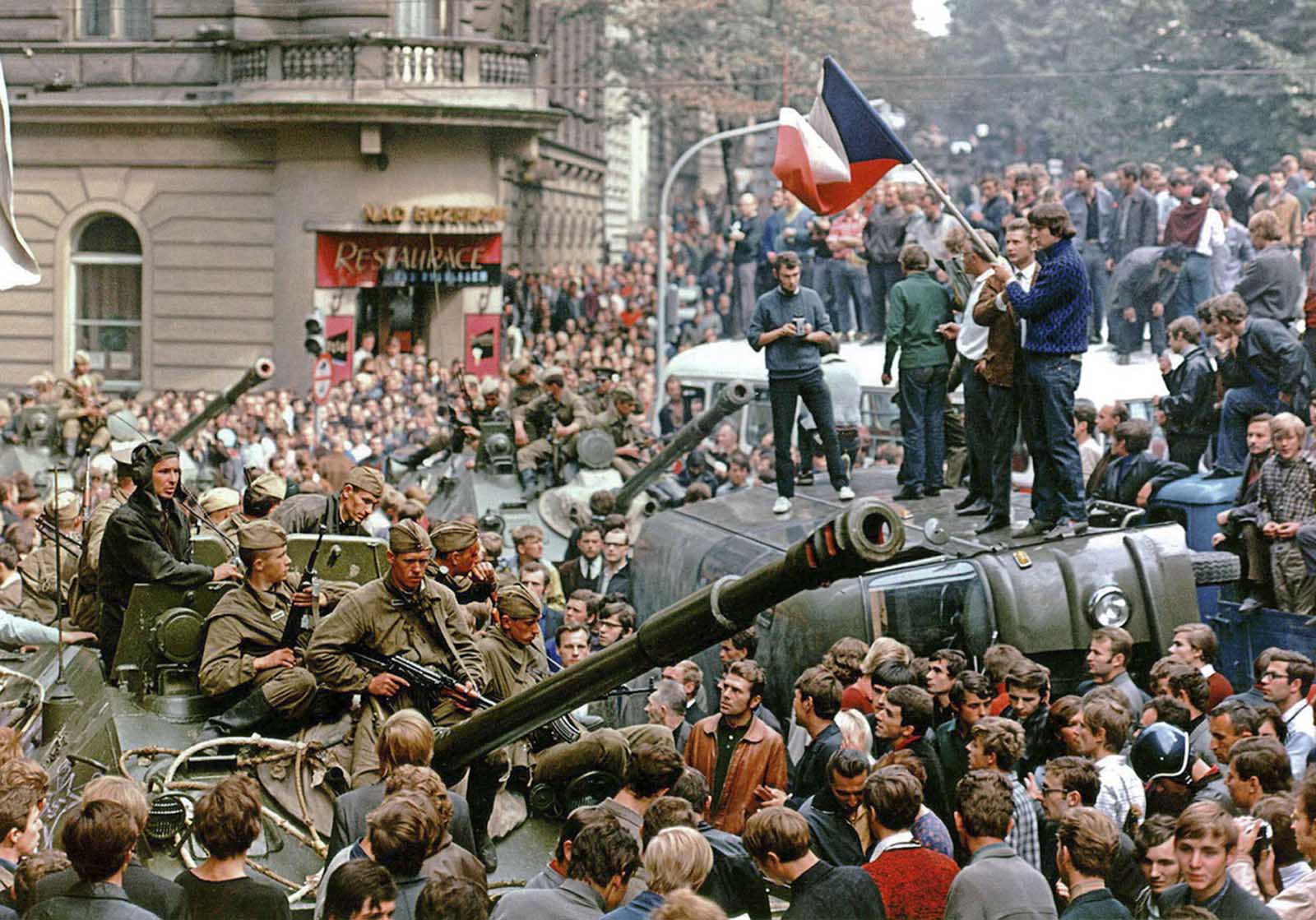
Crowds press in around Soviet tanks on a Prague street, turning an armored advance into a tense, human-scaled confrontation. Soldiers sit rigidly behind metal and weaponry while civilians climb onto the vehicles, their faces close enough to read doubt, anger, and resolve. Above the crush of bodies, a Czechoslovak flag rises into view, a vivid signal of identity and defiance amid the machinery of occupation.
In front of the Czechoslovak Radio building, the scene takes on added weight, because radio meant information, coordination, and the power to shape events in real time. The density of onlookers—spilling across sidewalks, steps, and the roadway—suggests a city galvanized, determined to witness and to be seen. Details in the background, from shop signs to balconies filled with spectators, anchor the moment in everyday urban life even as it teeters toward violence.
Tanks dominate the foreground, yet the photograph’s lasting impact comes from the imbalance it exposes: weapons designed for war facing unarmed residents in a public square. It’s an unforgettable snapshot of Cold War-era resistance in Prague, capturing the fraught intersection of military force, civic courage, and the struggle for a national voice. For readers searching the history of Soviet intervention in Czechoslovakia and the fight over the airwaves at Czechoslovak Radio, this image offers a stark, crowded window into that conflict.