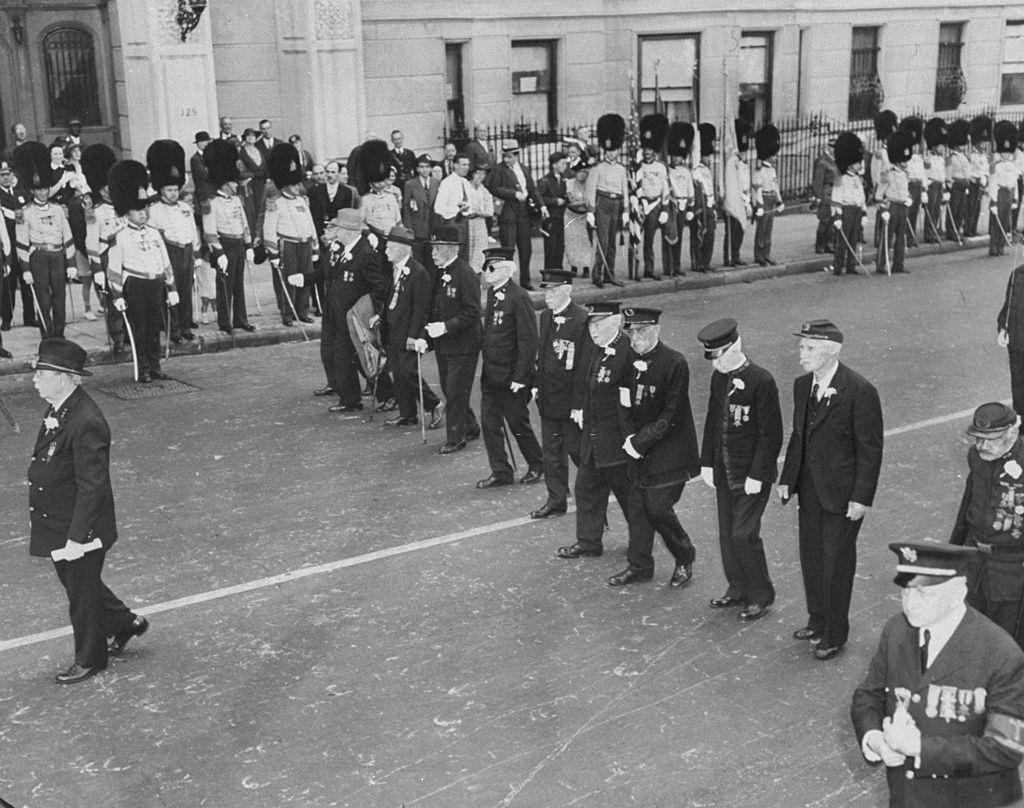
Along Riverside Drive in 1937, a small line of Civil War veterans moves through the Memorial Day Parade with the measured pace of age and ceremony. Dark suits, brimmed hats, and neatly pinned medals lend a formal dignity, while canes and careful steps hint at the long span between battlefield youth and public remembrance. The street itself becomes a quiet stage where personal history and national ritual meet.
Behind them, a row of uniformed guards stands at attention, their tall fur hats and upright posture forming a striking backdrop against the building’s stone façade and iron fence. Onlookers gather along the sidewalk, some leaning forward for a better view, others simply watching the procession pass. The contrast is vivid: the veterans’ subdued march set against the crisp symmetry of the parade’s pageantry.
Memorial Day in the interwar years carried a particular weight, and scenes like this one show how Americans used parades to keep the Civil War within living memory. These aging marchers, still wearing their service marks, embodied a generation that was rapidly disappearing even as the country faced new uncertainties. For readers searching Civil War veterans, Memorial Day Parade history, or 1930s Riverside Drive photographs, this image offers a poignant glimpse of commemoration in motion.