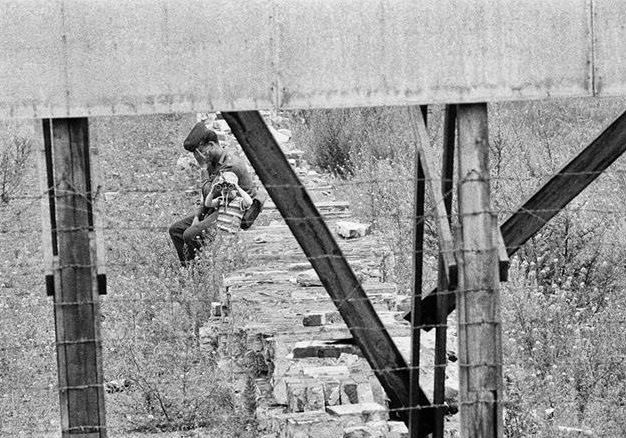
Along the Berlin border, a small boy and an East German border guard share a moment that feels almost ordinary—until the barbed wire in the foreground insists otherwise. The child, perched close to the uniformed figure, lifts binoculars to his eyes and peers toward West Berlin, turning curiosity into a quiet act of looking across a forbidden line. Steel posts, taut strands, and rough ground frame them both, compressing play and patrol into the same narrow strip of space.
The composition draws your gaze through layered obstacles: the fence dominates the front of the scene, while the pair sit beyond it on a stark, elevated boundary of stone and earth. This is Cold War Berlin in miniature, where surveillance, separation, and everyday life collided along the border between East and West. The guard’s posture reads as watchful but not hurried, and the boy’s intent focus suggests how early the division could enter a child’s world—through rules, warnings, and the simple lure of what lies just out of reach.
For readers searching for Berlin Wall history, East German border guard photos, or glimpses of daily life along the East–West Berlin frontier, the image offers a poignant contrast: innocence set against infrastructure built for control. It also echoes the human scale behind geopolitical language, hinting at families split by policy and neighborhoods reshaped by barriers. In the end, the binoculars become more than a toy—they are a symbol of longing, distance, and the enduring desire to see beyond the wire.