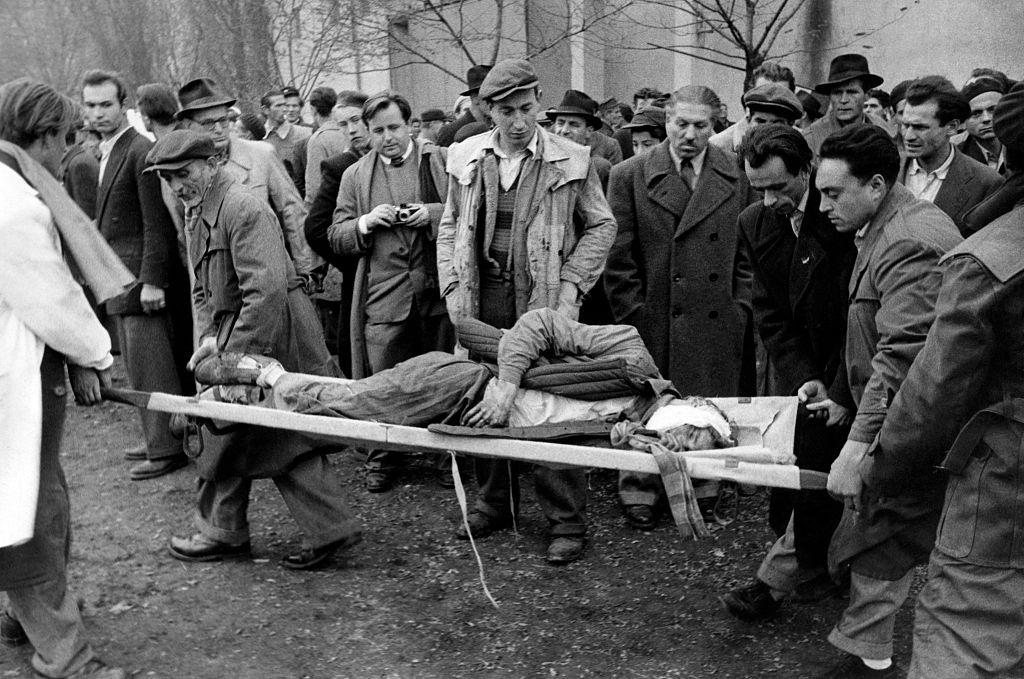
A dense ring of onlookers presses in as a wounded man is carried on a stretcher, his body strapped down and his head heavily bandaged. Faces tilt toward him with a mix of urgency and helpless attention, while the stretcher-bearers—men in work jackets and caps—move with the careful coordination of people who have done this before. The street feels like a corridor carved out of chaos, with winter trees and hard building lines framing a moment where survival depends on speed and steady hands.
Set in Budapest during November 1956, the scene belongs to the violent struggle around the headquarters of the Communist Party, one of the flashpoints of the Hungarian Revolution. The title’s word “patriot” signals how participants and witnesses interpreted the fighting: not as distant politics, but as a national crisis measured in blood and broken bodies. In the background, a man holds a small camera—evidence that even amid civil conflict, people felt compelled to document what they were living through.
Improvised aid stations were a lifeline in those days, and this photograph puts that reality front and center: medicine reduced to bandages, stretchers, and whatever shelter could be found nearby. It is a stark reminder that revolutions are remembered not only in slogans and speeches, but in the practical work of carrying the injured through crowded streets. For readers searching for historical photos of the Hungarian Revolution of 1956, Budapest street scenes, or the human cost of civil wars, this image offers an unvarnished, immediate record.