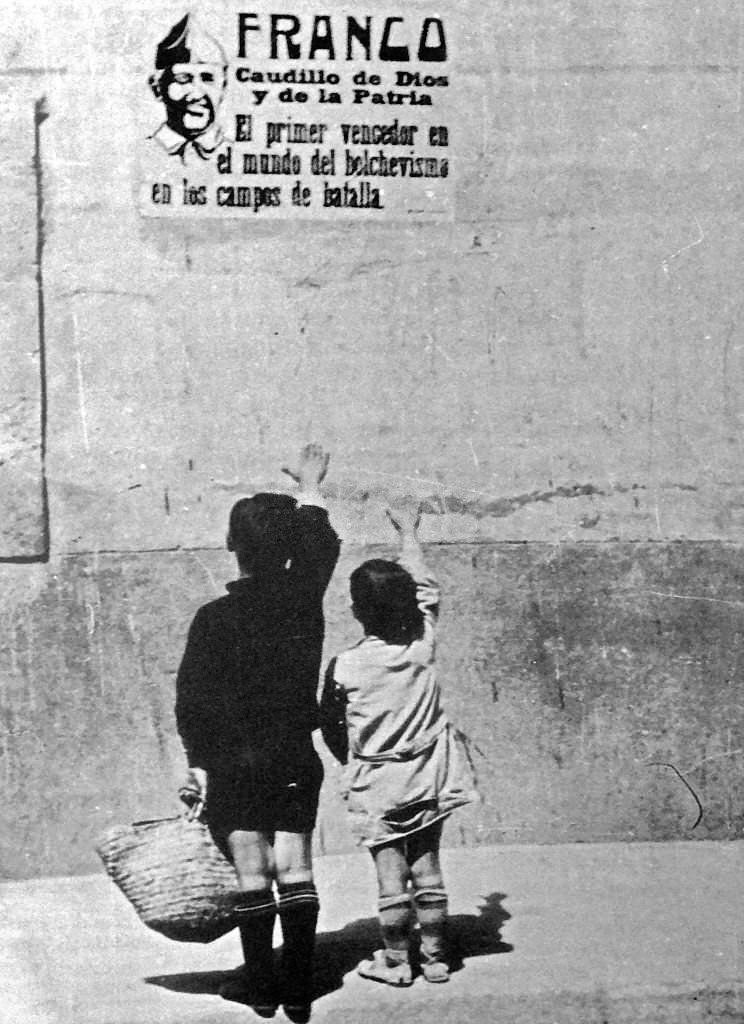
Against a bare plaster wall, two children lift their arms in salute toward a pasted poster bearing the bold name “FRANCO.” The paper’s Spanish slogan, crowned by a stylized portrait, turns an ordinary street surface into a message board, while the children—seen from behind—become part of the scene’s uneasy choreography. One holds a woven basket at their side, a quiet reminder that daily errands and wartime politics could occupy the same moment in 1937 Spain.
Propaganda during the Spanish Civil War relied on repetition and visibility, and the stark contrast here is striking: small figures beneath oversized lettering, private lives dwarfed by public declarations. The wall itself looks worn and scuffed, as if layers of posters and time have already passed over it, yet the command to look up and align with authority remains crisp. Even without a crowd, the gesture reads as a public performance, suggesting how political loyalty was taught, observed, and expected.
For readers searching Spanish Civil War history through photographs, this image offers a focused glimpse into the home front, where allegiance was cultivated not only at the front lines but in neighborhoods and schools. It invites questions about childhood under conflict, the power of slogans, and the ways regimes seek legitimacy through youth. The scene is simple, almost quiet, yet it carries the weight of a society being reshaped in real time by civil war and authoritarian messaging.