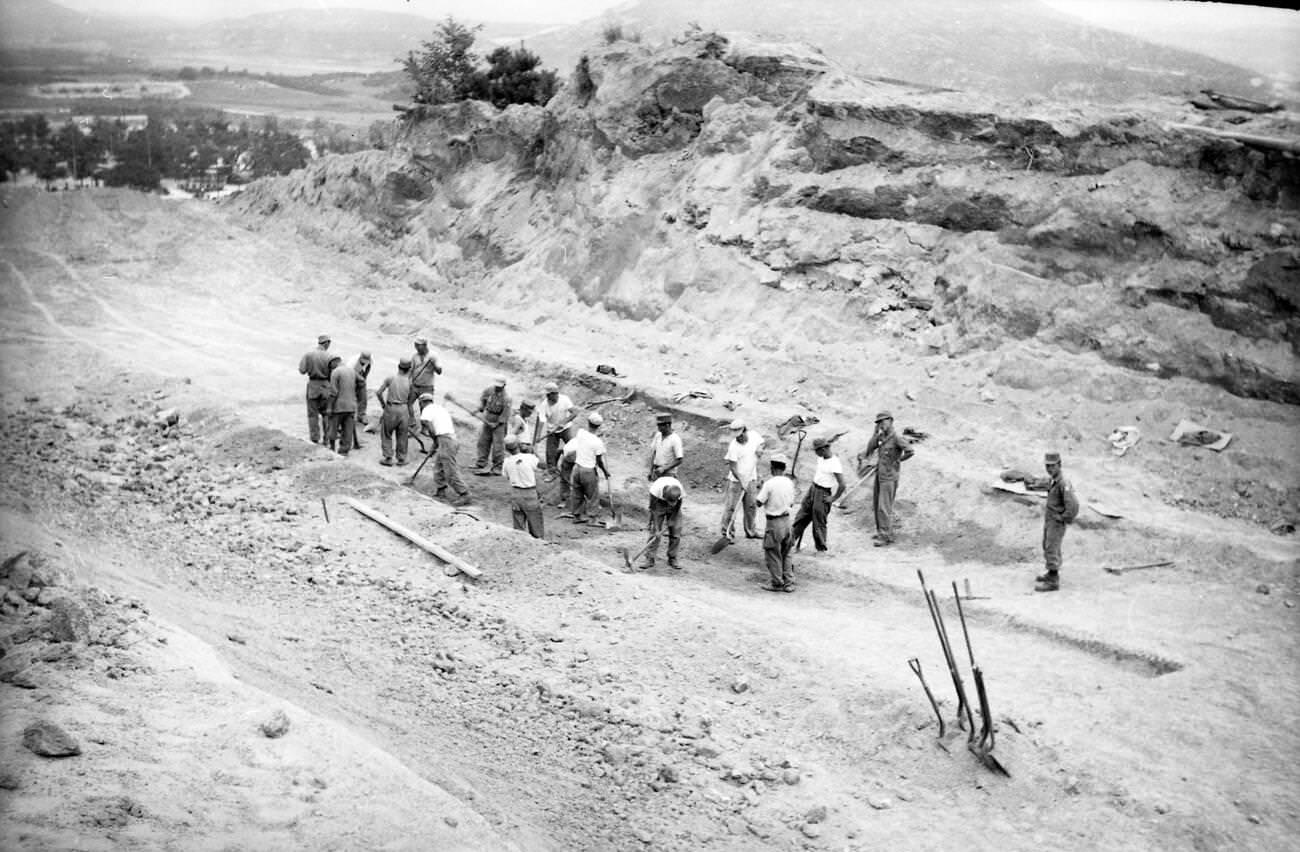
Cut into a barren hillside, a rough construction trench stretches across the frame while a cluster of South Korean soldiers and civilian workers gather in the open earth. Shovels bite into packed soil and rock, and a few men stand back to watch or direct the effort, their posture suggesting the mix of discipline and improvisation common on mid-century work sites. Beyond the excavation, the landscape falls away toward a distant settlement, placing this labor in the broader setting of a country rebuilding its infrastructure.
Dirt, stone, and hand tools dominate the scene, with no heavy machinery visible—an immediate reminder of how much postwar building relied on manpower and coordination. The group’s varied clothing and stances hints at a shared task carried out under different roles, likely shaped by military organization and local experience. Even the scattered boards and the spare tools stuck upright in the ground read like a moment paused between shifts, when the day’s work is measured in shovelfuls.
Taken in South Korea in 1955 on a US Army construction site, the photograph points to the practical realities of alliance and reconstruction in the early Cold War era. Projects like this helped establish the roads, facilities, and logistical networks that supported military presence while also influencing local employment and daily life. For readers interested in Korean War aftermath, US Army engineering, and the history of labor on military bases, this image offers a grounded, human-scale view of how landscapes were reshaped one trench at a time.