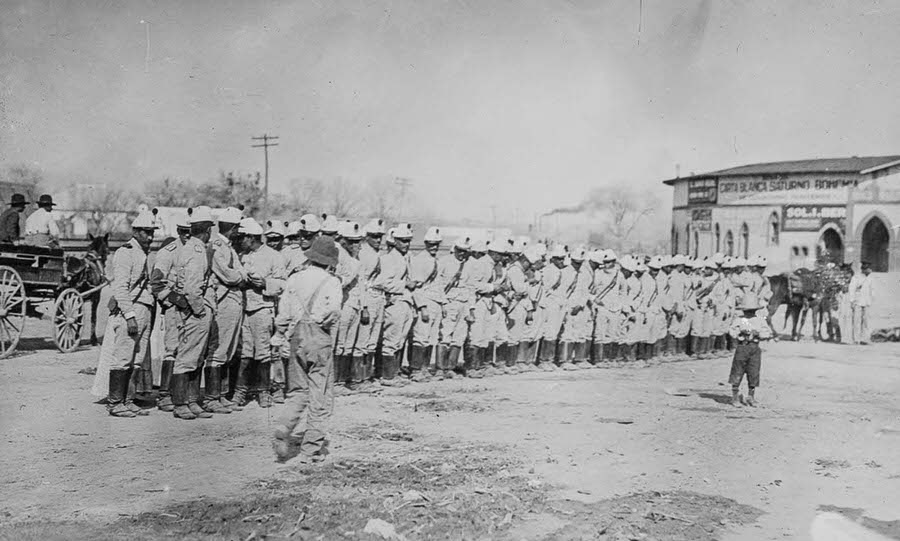
A long line of General Navarro’s federal troops stands at attention on open ground near a bullring in Ciudad Juarez, their light uniforms and helmets catching the harsh border sun. Rifles are held close and evenly spaced, while an officer in the foreground appears to be directing the formation. To the side, a wagon and mounted figures hint at the mix of foot and horse that still defined military movement in this era.
Behind the soldiers, the edge of town presses in: telegraph poles rise above the horizon and the bullring’s exterior shows arched openings and painted signage, a reminder that civic life and conflict often occupied the same streets. The contrast is striking—an entertainment venue turned landmark for mobilization—suggesting how quickly familiar public spaces could be repurposed during civil wars. Dusty ground and sparse vegetation reinforce the sense of a working, contested landscape rather than a ceremonial parade.
For readers interested in Ciudad Juarez history and the wider story of federal forces on Mexico’s northern frontier, the photo offers more than a simple lineup; it’s a snapshot of organization, authority, and tension on the eve of action. Details like uniformity in dress, the presence of mounted men, and the proximity to a bullring help anchor the scene in the everyday infrastructure of a border city. As a historical image, it invites closer looking at how armies moved, gathered, and made their presence visible during periods of internal struggle.