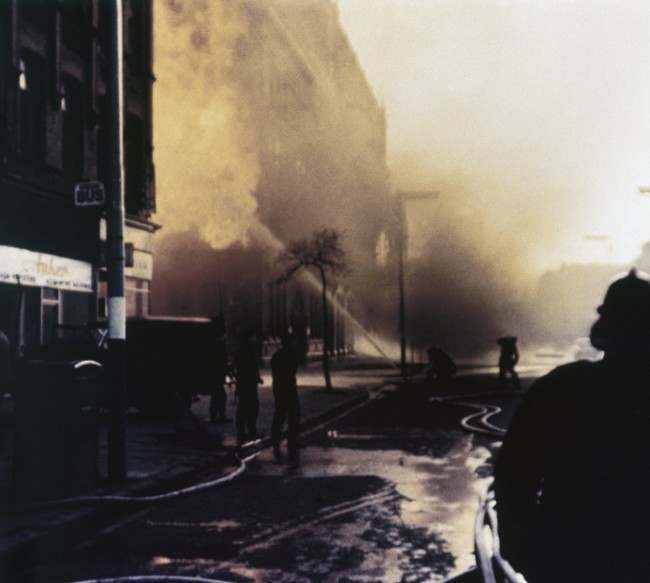
Smoke dominates the Belfast street scene as a factory building burns in 1971, turning daylight into a hazy, amber-grey veil. A line of firefighters and onlookers stands in silhouette against the glow and drifting fumes, while thick hoses snake across the wet roadway. The blurred outlines of nearby buildings and shopfronts suggest an ordinary commercial block abruptly transformed into an emergency zone.
Water streams toward the fire, catching what little light remains and reflecting in puddles that mirror the chaos overhead. The scale of the smoke plume hints at an intense blaze inside an industrial structure, where packed interiors and heavy materials could quickly feed the flames. Even without close-up detail, the photograph conveys the tension of a fast-moving incident—people braced in the street, equipment deployed, visibility collapsing.
Set against the broader atmosphere of civil unrest associated with Northern Ireland in the early 1970s, this Belfast factory fire reads as more than a single dramatic moment. It speaks to vulnerability in the built environment and the fragile routines of work and commerce when crisis arrives. For readers searching for a historical photo of Belfast in 1971, the image offers a stark, street-level view of fire, smoke, and response in a city under strain.