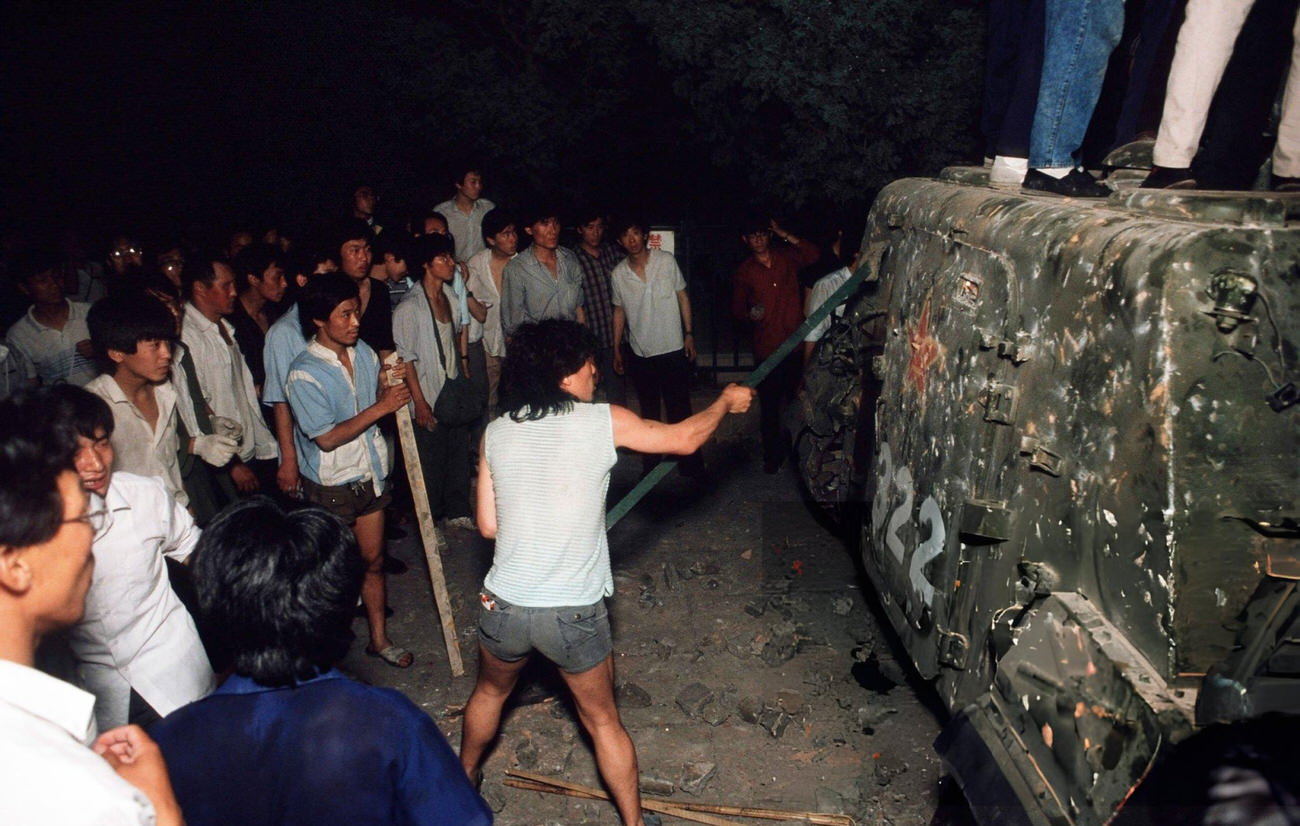
Night presses in on a tense street scene as pro-democracy demonstrators crowd around an armored personnel carrier, its metal sides scraped, dented, and marked by fresh impact. A protester in the foreground swings a length of material toward the vehicle while others watch closely, some gripping boards and makeshift tools. The harsh flash lighting and deep shadows emphasize the urgency of the moment, capturing a confrontation where bodies, steel, and fear share the same narrow space.
The armored carrier dominates the right side of the frame, its heavy wheels and riveted panels a reminder of the state’s capacity for force, even as civilians attempt to overwhelm it with numbers and determination. Faces in the crowd register a mix of anger, apprehension, and resolve; a few people stand slightly back, gauging the risk, while others press forward. Debris scattered on the ground suggests prior clashes nearby, turning the roadway into an improvised battleground rather than a place of ordinary movement.
Set against the title’s “1989,” the photograph belongs to a year synonymous with mass protest and political upheaval, when demands for reform and representation erupted in many places and were often met with militarized responses. It also fits the post’s “Civil Wars” theme in a broader sense, illustrating how internal conflicts can surface in public squares and streets long before they are formalized in history books. For readers searching for “1989 pro-democracy protests,” “armored personnel carrier,” or “street confrontation,” this image offers a stark, immediate glimpse into the perilous edge where popular movements collide with state power.