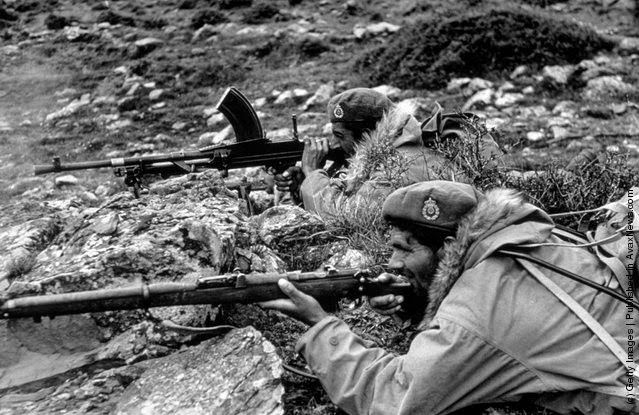
Against a stony hillside near Karpenisi, Greek government commandos lie low behind rocks and scrub, rifles trained downslope as if waiting for a sudden movement. British-style berets sit tightly on their heads, while American fur-trimmed jackets add bulk and warmth—practical gear for rough terrain and colder mountain air. The tight framing keeps the viewer close to the ground, emphasizing tension, cover, and the hard physical reality of fighting in the open.
Gear tells its own story here, hinting at a conflict shaped by international supply lines as much as by local geography. The juxtaposition of British headwear and American outerwear speaks to the postwar moment when uniforms, weapons, and training flowed across borders, ending up on the backs of men navigating Greece’s internal struggle. Even without a named unit or a clearly marked landmark, the image conveys how modern kit met old landscapes in a civil war defined by mobility and ambush.
Karpenisi and the surrounding region were known for mountainous approaches where small groups could disappear into ravines and reappear along ridgelines, and the photograph leans into that reality. Faces are partly obscured by posture and brim, yet body language remains readable: focus, discipline, and the quiet urgency of a patrol turned firefight. For readers searching Greek Civil War history, Cold War-era military aid, or wartime photography from Greece in 1948, this scene offers a vivid, grounded glimpse of soldiers at the edge of the country’s upheaval.