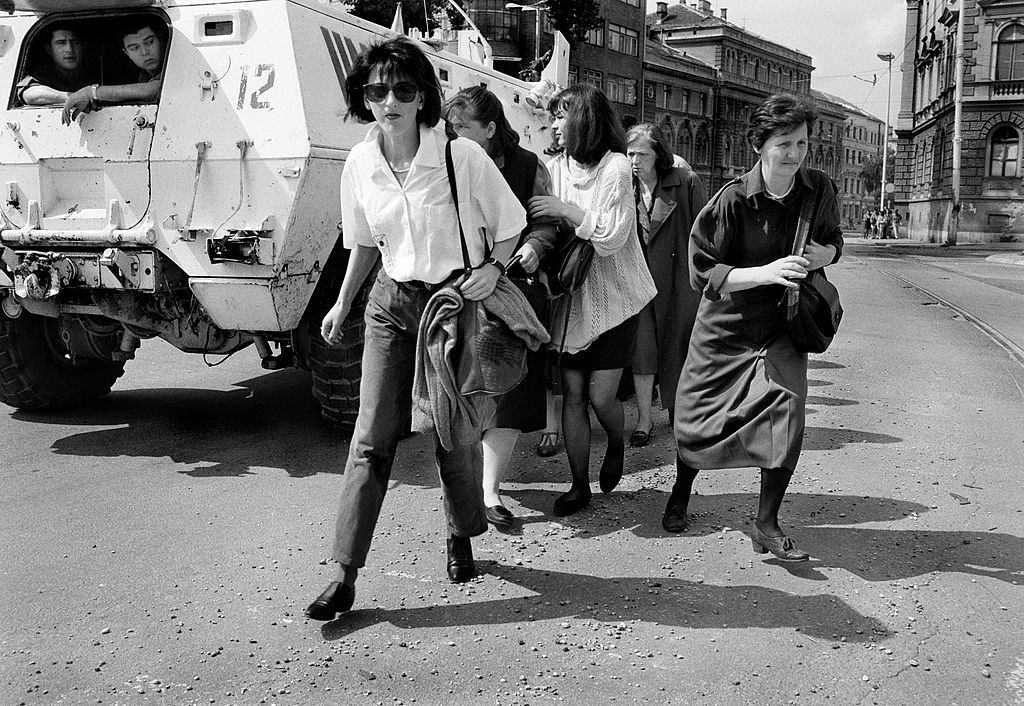
Urgency hangs in the air as a group of women moves alongside a UN armoured personnel carrier, using its bulky frame as a moving wall while they cross Sarajevo’s infamous “Sniper Alley” during the siege. The street is wide and exposed, the kind of open corridor that offers little shelter, while the vehicle’s angled armour and heavy wheels signal both protection and peril. Two faces peer from a hatch, watching the civilians pass, a small human detail amid hard metal and tense motion.
Clothing and handbags, a cardigan clutched against the body, a quick stride and lowered shoulders—everyday items take on new meaning when survival depends on seconds. The women keep close together, stepping over scattered grit and debris on the road, with tram tracks and tall city buildings stretching into the background. In the stark contrast of the photograph, the normal outlines of urban life remain visible, yet everything is reframed by the calculations of a civil war fought street by street.
The title’s reference to 1995 places this scene near the end of a long siege that made Sarajevo a global symbol of besieged civilians and perilous commutes for water, work, or family. UN peacekeepers and their vehicles appear here as both shield and reminder of international presence that could not fully erase danger. For readers searching for historical photos of the Bosnian War, the Sarajevo siege, or “Sniper Alley,” the image distills the conflict into a single passage across an open road—ordinary people navigating extraordinary threat.