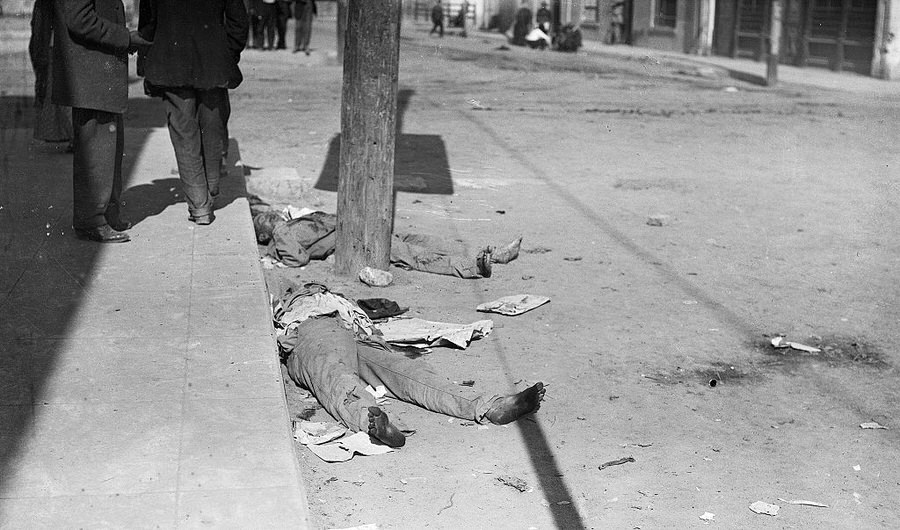
Along the edge of a city sidewalk, bodies lie where they fell, half in the gutter and half in the open street, as scattered papers and debris mark the chaos of a recent battle. A utility pole stands like a stark divider in the frame, emphasizing how ordinary urban infrastructure can become a backdrop to sudden violence. The setting reads as a commercial block with shopfronts and wide pavement, turning a familiar streetscape into a scene of aftermath and shock.
Nearby, a few onlookers hover at a distance while others stand close enough to cast long shadows over the fallen, their posture suggesting stunned observation rather than action. The clothing and street layout hint at an early era of urban warfare, where civilian spaces were exposed to fighting that belonged, in theory, to the front lines. The camera’s low angle and uncompromising clarity insist on the human cost, capturing not heroism but the stillness that follows gunfire.
For readers tracing the visual record of civil wars, this photograph serves as a sobering primary source: it documents how conflict collapses the boundary between battlefield and neighborhood. Details like the curb, the scattered personal effects, and the empty stretch of road help convey the speed with which normal life can be interrupted and erased. Used thoughtfully, the image supports discussions of street fighting, wartime casualties, and the ways cities absorb—and remember—the violence done within them.