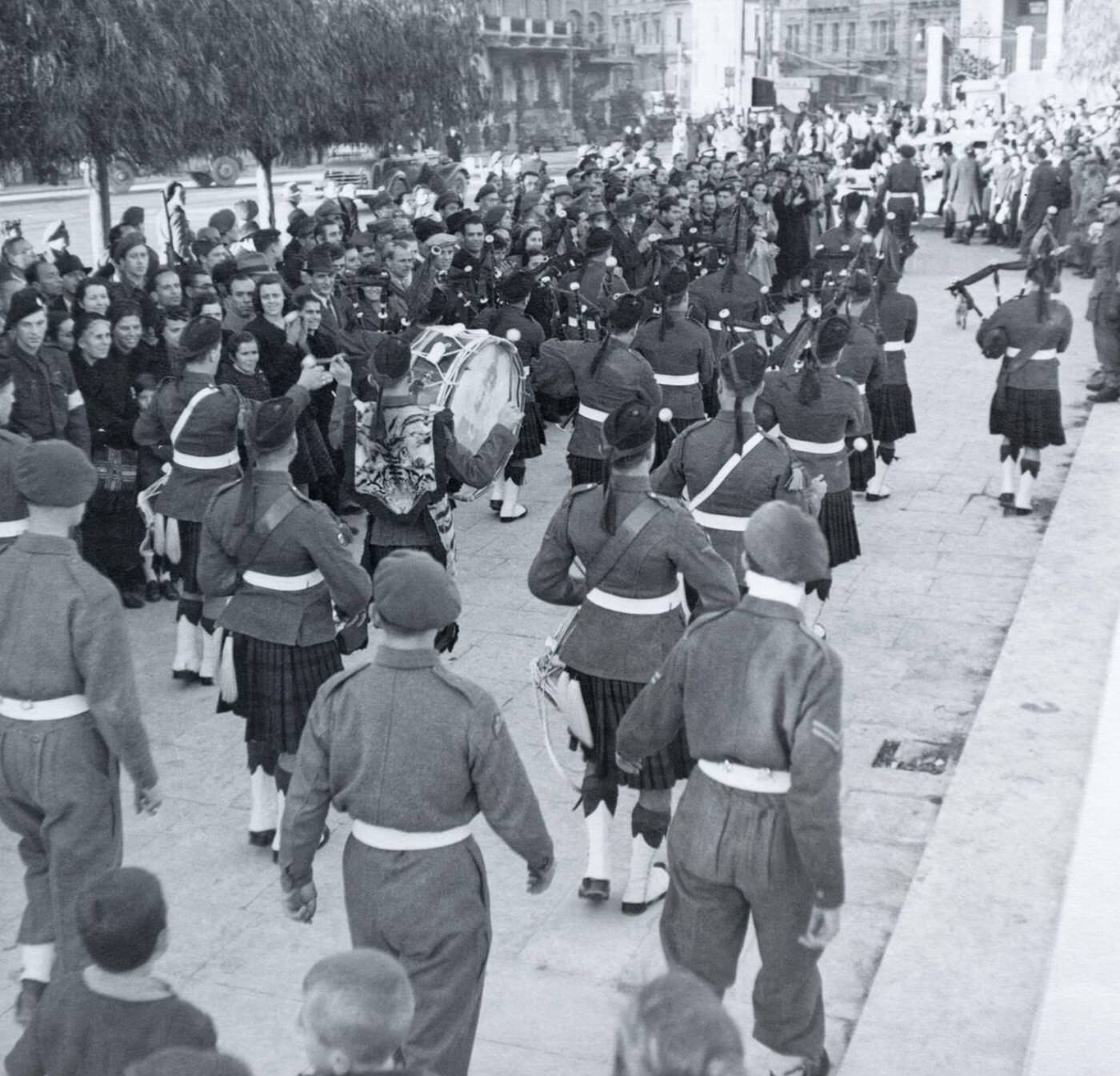
Kilted pipers and drummers step smartly down a broad Athens street, their instruments lifted and uniforms crisp, while British soldiers of the Parachute Regiment keep pace nearby in berets and battledress. The crowd presses in from the left, faces turned toward the marching column, with a mix of curiosity and relief that feels unmistakably postwar. Even in a still frame, the rhythm is easy to imagine: drumskins taut, bagpipes angled, boots landing in time on the city pavement.
Athens in 1945 was not simply a backdrop for victory celebrations, but a place where wartime alliances and local tensions collided in the shadow of civil conflict. The title’s pairing of paratroopers and a Scottish band hints at the public performance of authority—order demonstrated through drill, music, and ceremony—at a moment when Greece’s future was being contested in streets as well as in politics. The onlookers’ close proximity, and the soldiers’ controlled spacing, give the scene a charged intimacy rather than a distant parade-ground formality.
Seen today, this historical photo speaks to the complicated texture of liberation and occupation, festivity and unease, that defined much of Europe’s immediate post–Second World War transition. Details like the band’s tartan and the soldiers’ insignia anchor the image in British military history, while the setting firmly roots it in wartime Athens and its aftermath. For readers searching for Parachute Regiment history, Scotland’s military bands, or Greece’s turbulent 1940s, the photograph offers a vivid doorway into the era’s contradictions.