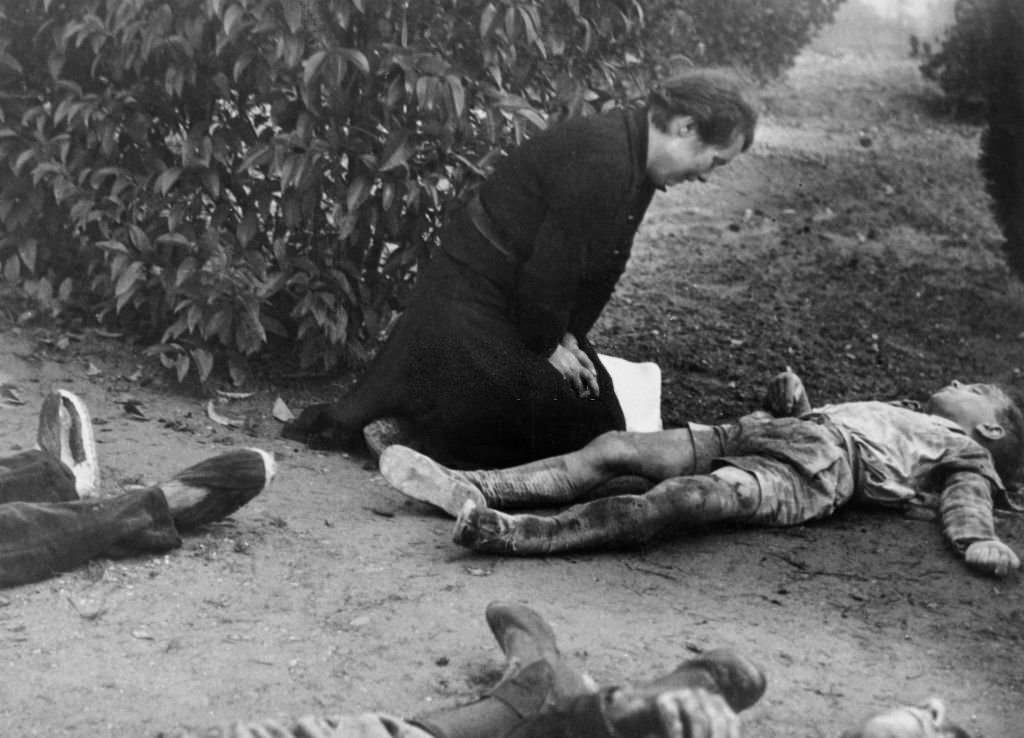
On a roadside in Lleida (Lérida), a mother kneels beside her child, her posture folded into grief as the boy lies motionless on the dirt. The scene is stark and unadorned—bodies on the ground, scattered footwear, and a line of trees that should suggest calm but instead frames a moment of sudden violence. The mother’s attention fixes on her son, turning a public catastrophe into an intimate, unbearable loss.
Wartime bombing during the Spanish Civil War did not confine itself to front lines; it tore into streets, fields, and ordinary routines, leaving civilians to absorb the consequences. Details in the photograph—the child’s small clothing, the dust on skin, the way the road stretches away—underscore how quickly everyday life can be shattered. There is no heroism posed for the camera here, only the raw aftermath of an attack and the silence that follows.
Remembering images like this is part of understanding the Spanish Civil War beyond politics and military campaigns, because it reveals the human cost carried by families. For readers searching for historical photos of Spain in the 1930s, civil war bombing raids, and civilian casualties, this photograph stands as a sobering record of what aerial warfare meant on the ground. It asks us to look closely and to reckon with the private tragedies that make up the larger history.