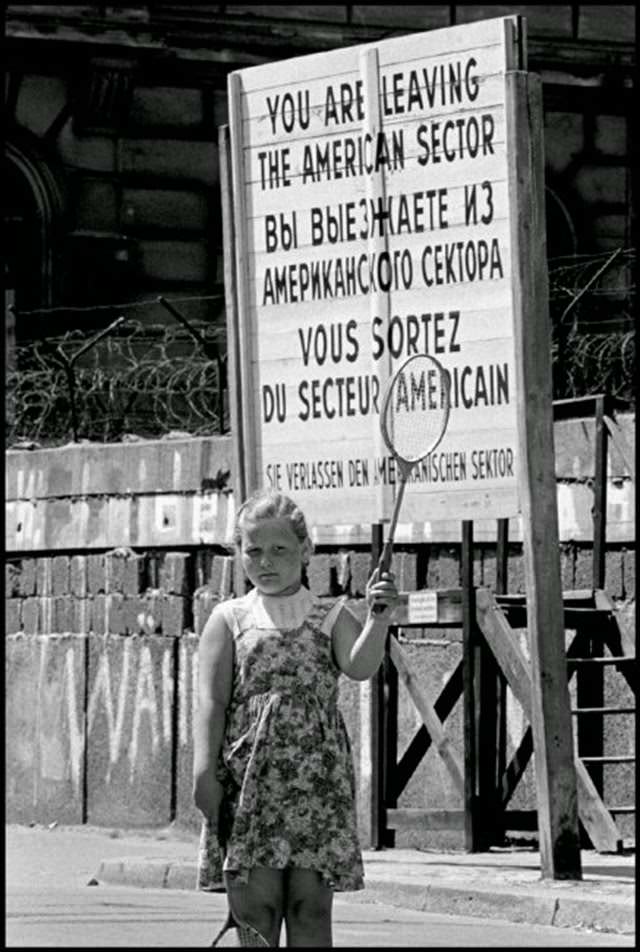
A child stands in the foreground of Berlin Wedding, holding a hoop-like toy as if it were a wand, while a stark checkpoint sign looms behind her: “YOU ARE LEAVING THE AMERICAN SECTOR,” repeated in several languages. The contrast is immediate—playground innocence set against the bureaucratic language of borders, control, and occupation. Even without seeing soldiers, the message of divided Berlin is unmistakable, written large over an ordinary street.
Behind the sign, rough fencing, stacked materials, and coils of barbed wire hint at the physical reality of the Berlin Wall’s barrier system, where everyday routes could end abruptly. The scene feels improvised and tense: a neighborhood edge turned into an international boundary, a place where a child might wander within sight of symbols meant to warn adults. In this kind of Cold War street photography, small details—handmade structures, the harsh typography, the mix of languages—tell the story of a city managed by sectors and watched by history.
Berlin Wedding often appears in accounts of West Berlin as a working district shaped by proximity to the Wall, and this photo captures that atmosphere without needing spectacle. The title’s focus on children playing at the Berlin Wall underscores a haunting normality: life continuing in the shadow of division, where games and growing up happened alongside restrictions and fear. For readers searching for historical Berlin Wall images, American Sector signage, and everyday life in divided Berlin, this photograph offers a vivid, human-scale window into a world defined by boundaries.