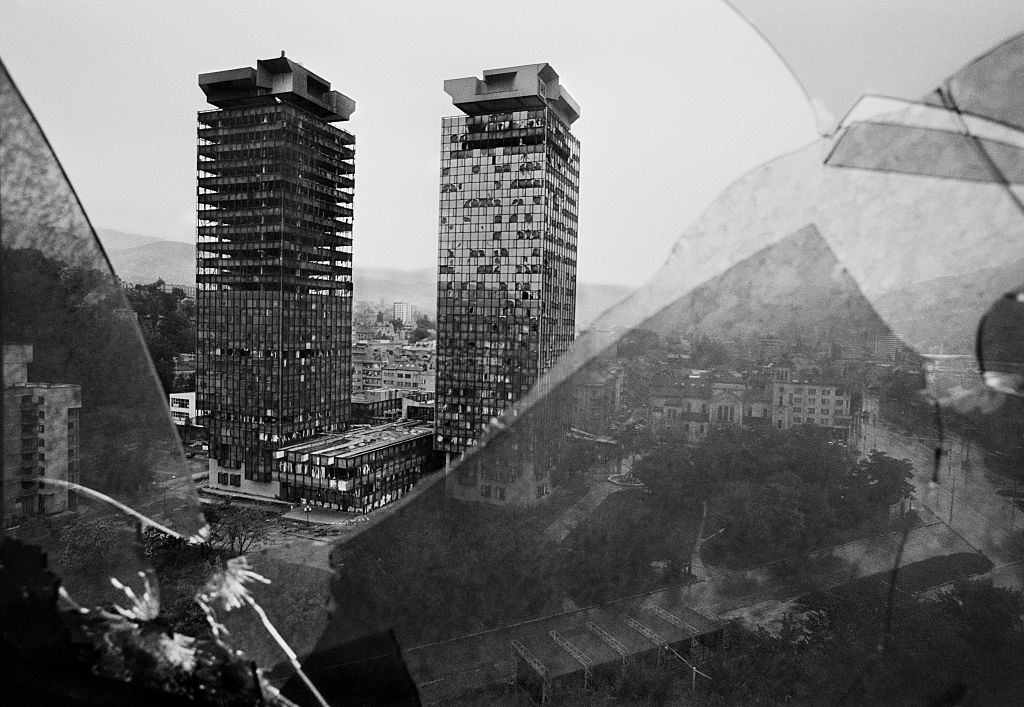
Jagged shards of glass dominate the foreground, turning the Holiday Inn’s broken window into both frame and witness as Sarajevo’s financial district rises beyond it. Two tower blocks stand scarred and hollowed, their darkened façades and missing panes forming a grid of damage against a pale sky. In the distance, low hills and tightly packed buildings recede into haze, emphasizing how war’s violence reached from skyline to street level.
The composition makes the viewer feel uncomfortably present, as if looking out from a room abruptly transformed into a lookout. Where these high-rises once signaled modern commerce and confidence, they now read as burnt-out shells—vertical monuments to a city under siege and the collapse of everyday routines. The shattered glass isn’t just debris; it’s a visual metaphor for fractured security, forcing the eye to navigate ruin before it can even take in the horizon.
For readers searching Sarajevo war photography, Bosnian conflict history, or images of urban destruction in civil wars, this photograph offers a stark, architectural record of a pivotal European city in crisis. It captures how quickly landmarks of prosperity can become targets and how the built environment preserves the memory of violence long after the gunfire fades. Seen through the Holiday Inn’s damaged panes, the ruined towers underscore the uneasy intersection of journalism, civilian life, and survival in wartime Sarajevo.