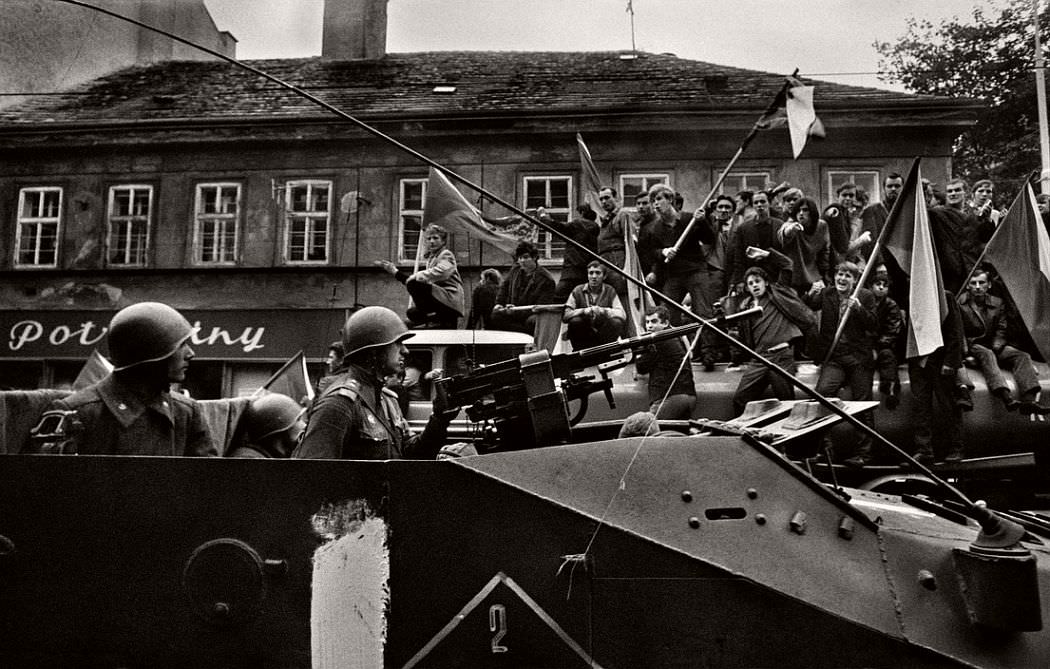
Armored vehicles roll through a crowded street as helmeted soldiers scan the sidewalks and rooftops, their weapons and radio antennas cutting sharp lines across the frame. Above them, civilians press together on a raised perch, gripping flags and staring down at the convoy, a tense mix of defiance, fear, and disbelief written into their faces. The closeness between occupiers and onlookers makes the scene feel claustrophobic, as if the city itself has been forced into a narrow corridor with no room to breathe.
In the context of the Soviet invasion of Czechoslovakia, the photograph speaks to the abrupt end of the Prague Spring and the crushing weight of Cold War power politics. It isn’t a distant battlefield image but an urban confrontation—steel and authority moving through everyday spaces where people normally shop, work, and gather. That contrast is the story: ordinary streets turned into arenas where sovereignty, reform, and obedience collide in public view.
Details like the packed windows, the improvised vantage points, and the flags held aloft help anchor this as more than military hardware on the move; it is a record of a population trying to assert presence when decisions are being imposed at gunpoint. For readers searching for Prague Spring history, Warsaw Pact intervention, or the 1968 Soviet crackdown, this moment captures the human scale of occupation—the split-second when a crowd and a column meet, and a nation’s hopes are tested in the open air.