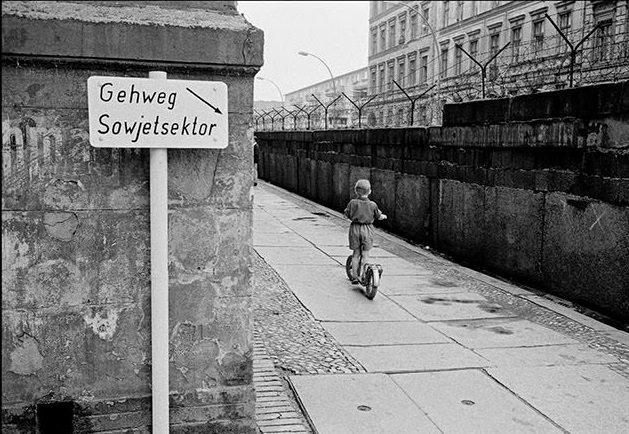
A hand-painted sign reading “Gehweg Sowjetsektor” points into a narrow pedestrian way, marking in plain language how Berlin was carved into zones of control. The rough concrete, patched surfaces, and utilitarian paving set a stark tone, while the wall’s hard edge leads the eye forward like a corridor with no easy exit. Even without a crowd, the scene feels supervised—built to direct bodies, limit choices, and make borders part of everyday routine.
Down the path, a small child rides a scooter away from the camera, framed by the looming Berlin Wall and the dense line of barbed wire above it. That contrast—playful motion against militarized architecture—turns an ordinary moment into a quiet statement about life in a divided city. The long perspective emphasizes distance and separation, as if the sidewalk itself has been drafted into the Cold War.
Details like the warning sign, the watchful fencing, and the near-empty street capture the Berlin Wall not as an abstract symbol but as a lived environment. For readers searching for Berlin Wall history, Soviet Sector Berlin, or Cold War street photography, the image offers a grounded view of how borders reshaped urban space and childhood alike. It also echoes the post’s “Civil Wars” theme by reminding us that conflict doesn’t always roar; sometimes it settles into concrete, signage, and the daily routes people are allowed to take.