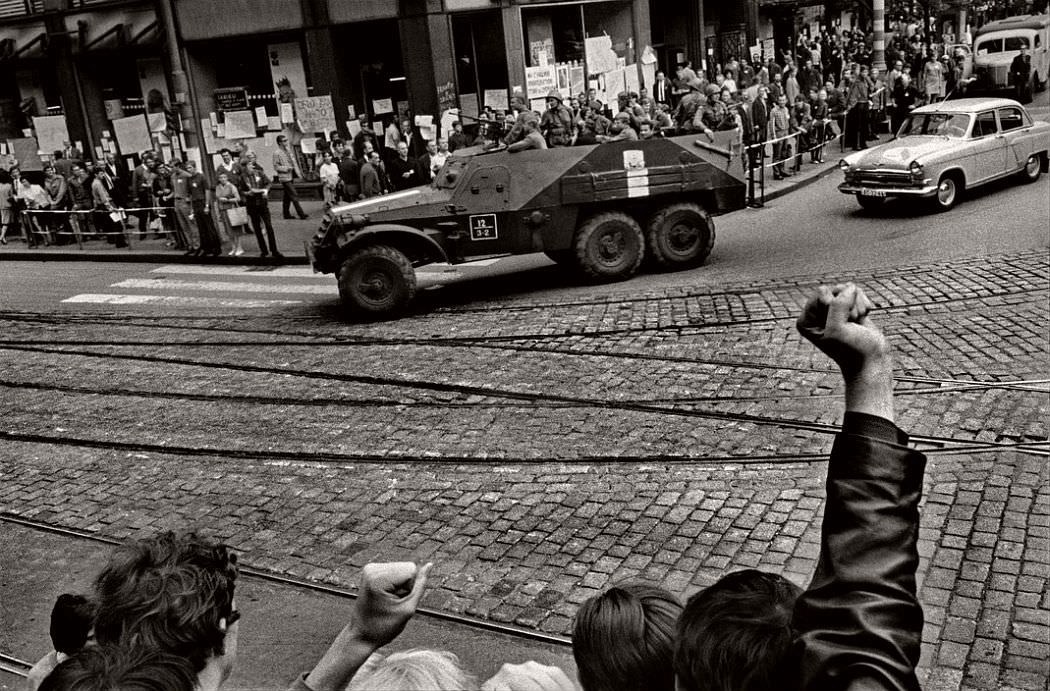
Armored vehicles roll along a cobbled city street as onlookers pack the sidewalks, their attention fixed on the sudden assertion of Soviet power during the 1968 invasion of Czechoslovakia. In the foreground, raised fists punctuate the scene with defiance, while shopfronts and streetcar tracks anchor the moment in everyday urban life interrupted by military force. The contrast between the heavy, angular silhouette of the carrier and the ordinary traffic nearby underscores how quickly normal routines can be swallowed by geopolitics.
Crowds appear not as a faceless mass but as individuals pressed behind barriers, some holding placards and signs that read as urgent appeals rather than organized spectacle. The photograph’s perspective—taken from within the onlookers—pulls the viewer into the tension of the Prague Spring’s abrupt halt, where protest and occupation share the same pavement. Even without hearing the chants or engines, you can sense a city negotiating fear, anger, and resolve in real time.
For readers exploring Cold War history, the Soviet invasion of Czechoslovakia remains a defining episode in the struggle over reform, sovereignty, and the limits of dissent inside the Eastern Bloc. This image captures the human scale of that confrontation: civilians confronting armored authority with little more than presence, gestures, and signs. It’s a powerful visual entry point into the story of 1968, the crushing of the Prague Spring, and the lasting memory of resistance in the streets.