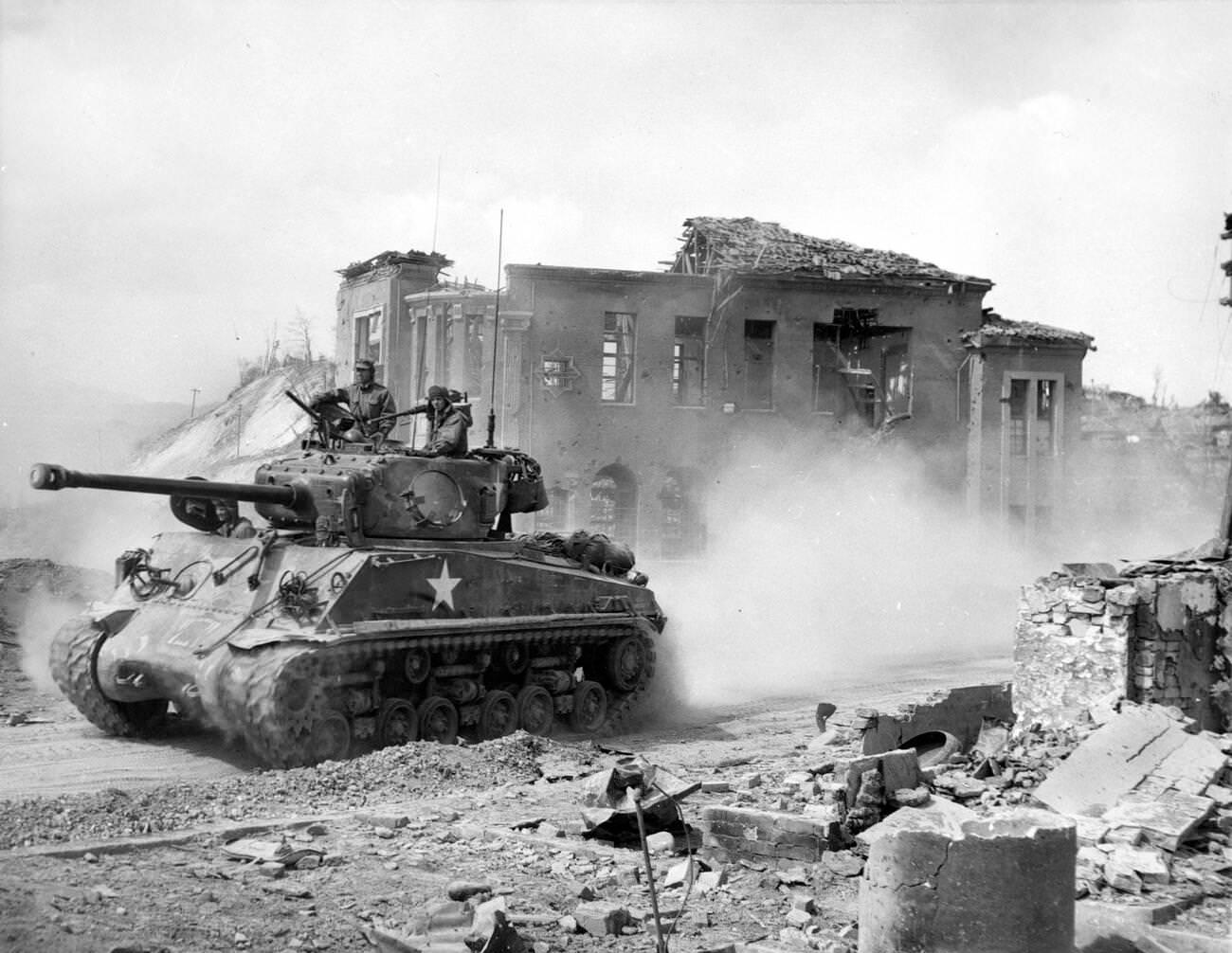
Dust hangs in the air as an American First Division tank pushes north through Chuncheon, its long gun barrel leading the way past shattered masonry and a roof torn open to the sky. The white star on the hull stands out against the grime of the road, while crewmen ride exposed on the turret, scanning a streetscape reduced to rubble. Even without sound, the scene suggests the grinding weight of armored movement—tracks biting into broken ground, debris shifting under steel.
Chuncheon’s battered buildings form a stark backdrop that speaks to the Korean War’s urban toll, where strategic routes and river valleys turned towns into contested corridors. The tank’s passage through a gutted block hints at a place recently fought over or repeatedly shelled, with walls left standing but windows blown out and interiors stripped bare. In the foreground, scattered stones and collapsed brickwork frame the human scale of destruction alongside the imposing machine built to survive it.
For readers searching Korean War history, U.S. Army armor, or 1951 photographs from South Korea, this image offers a concentrated glimpse of front-line logistics and the reshaping of everyday streets into military terrain. It captures the uneasy coexistence of motion and ruin: an advance measured in yards, guided by engines and orders, set against a city trying to endure. Seen today, the photograph invites reflection on how quickly modern conflict can turn familiar architecture into a battlefield—and how those moments were recorded for the historical record.