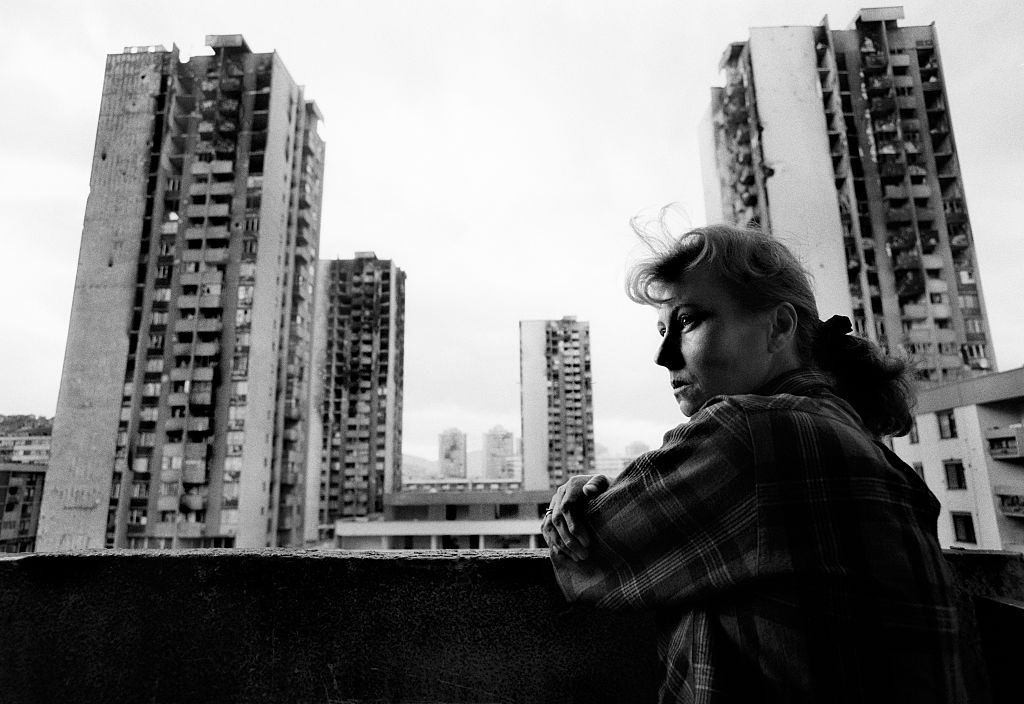
On a Sarajevo balcony, Minka Salihagic leans into the concrete railing, her profile set against a skyline of high-rises scarred by war. The stark light and deep shadows turn the apartment blocks into looming silhouettes, their pocked facades and broken windows hinting at the violence that reshaped everyday life. In the foreground, her stillness carries its own weight—part vigilance, part exhaustion—framing the human scale of a city under siege.
Heroes Square, as the title notes, earned its name not from monuments but from the extreme dangers of simply living there during the civil wars. The composition draws a hard line between domestic space and exposed streets: the balcony is both a refuge and a risk, a place to breathe and a place where one could be seen. Even without graphic action, the photograph speaks through absence—quiet rooms behind shattered glass, towers standing yet hollowed, and the persistent uncertainty of looking outward.
For readers searching for history of the Siege of Sarajevo, wartime Sarajevo photography, and civilian life during the Bosnian War, this image offers an intimate entry point. It reminds us that conflict is recorded not only in front lines, but in the routines people tried to maintain—watching the day, gauging danger, and holding on to normalcy in a neighborhood renamed by survival. In Minka’s gaze and the battered architecture around her, Sarajevo’s endurance becomes personal, immediate, and unforgettable.