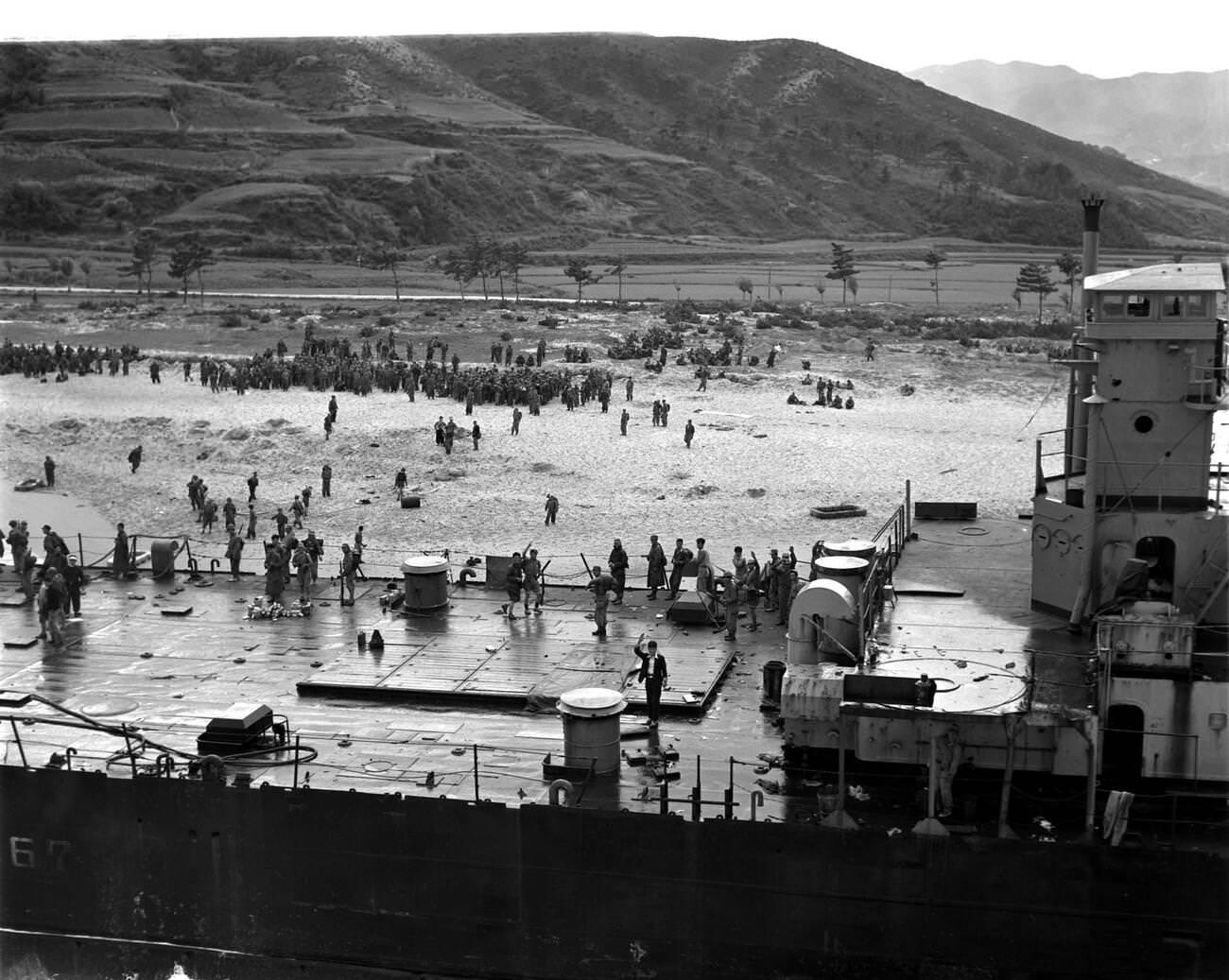
Along a broad Korean shoreline, dozens of small figures gather in loose formations while a landing vessel dominates the foreground, its steel deck cluttered with gear and movement. The contrast between the ship’s hard angles and the open beach beyond creates a sense of transition—men and materiel shifting from sea to land under watchful hills. In the distance, terraced slopes and sparse trees frame the scene, reminding viewers how often the Korean War unfolded in tight coastal corridors backed by rugged terrain.
ROK diversionary landings in 1950 were meant to complicate an enemy’s planning, pulling attention away from other operations and forcing rapid decisions along the coastline. The photo’s wide perspective hints at that uncertainty: troops spreading out, groups clustering, and individuals crossing the sand as if responding to orders that may change by the minute. Even without visible combat, the staging itself conveys the pressures of amphibious warfare—timing, coordination, and the constant need to secure a foothold before the landscape can turn hostile.
For readers searching Korean War photos or studying Republic of Korea forces in early 1950 campaigns, this image offers a grounded look at the logistics behind headline events. It captures a moment when strategy is visible in posture and spacing rather than in explosions—workmanlike urgency on the deck, patient massing on the beach, and a coastline that must be taken, held, and supplied. Seen today, the scene reads as both military history and human story: a temporary assembly on sand, poised between the sea’s delivery and the mountains’ resistance.