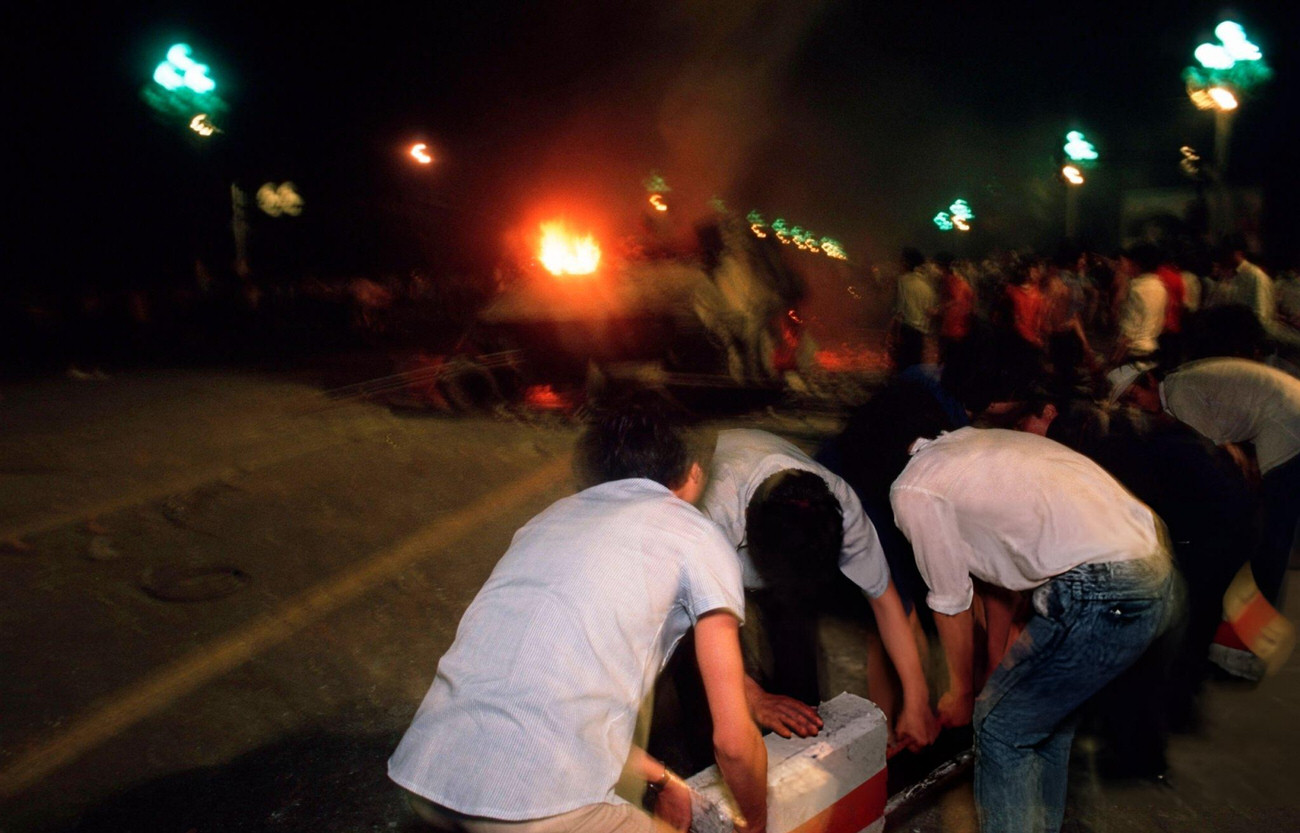
Streetlights smear into green halos as the scene jolts forward, a night of urgency on Changan Avenue in 1989. In the foreground, demonstrators bend low and strain together, dragging a heavy road barrier into place while the pavement glints under harsh, uneven light. A fire burns farther up the avenue, its orange flare cutting through smoke and blur, hinting at the heat and confusion surrounding the crowd.
The photograph’s motion and grain feel almost physical, as if the camera is running alongside the people it records. Bodies cluster in quick, nervous knots; some push, others look ahead, and the line of makeshift barricades suggests a street being remade in real time—closed, defended, contested. Even without visible slogans, the title frames this as a pro-democracy moment, where ordinary street infrastructure becomes a tool of resistance.
For readers interested in the 1989 pro-democracy demonstrations in China, images like this offer a ground-level view of how protest unfolds beyond speeches and banners: through coordination, improvisation, and shared risk. The intersection of barricades, smoke, and rushing figures evokes the wider global story of civil unrest and state power, while keeping the focus on the people doing the work of defiance with their hands. Set against one of Beijing’s most symbolic thoroughfares, the tension between public space and political control is unmistakable.