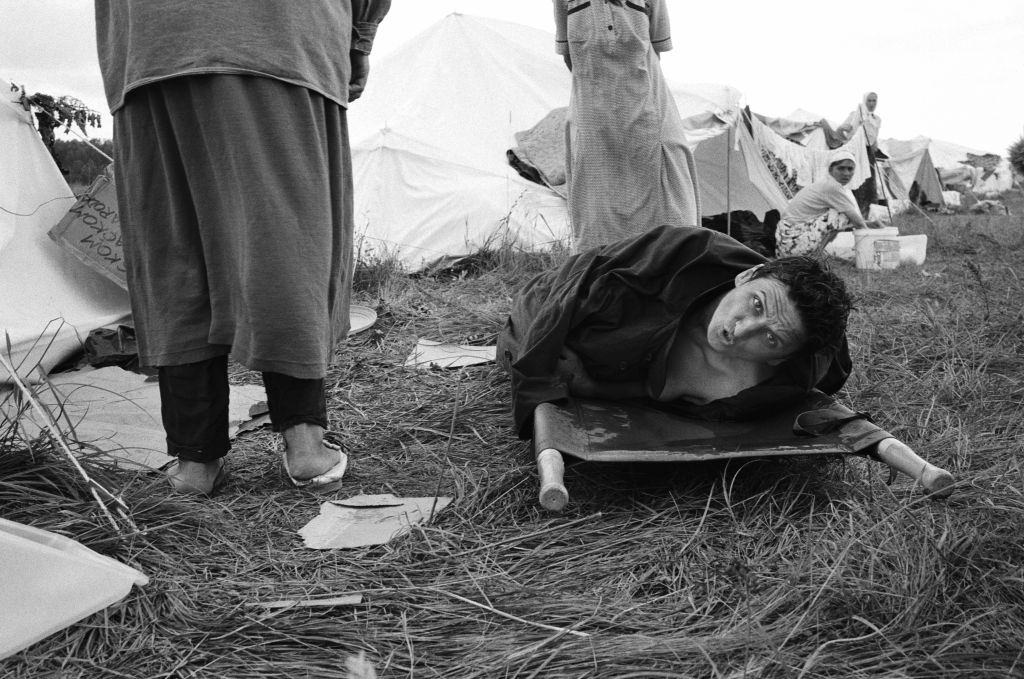
Near the edge of a line of makeshift tents, an injured woman lies on a low stretcher set directly on the grass, her face turned toward the camera with a stare that feels both exhausted and unblinking. Around her, the camp’s routines continue: women in long dresses and headscarves stand, crouch, and tend to the thin necessities of survival amid scattered paper, buckets, and uneven ground. The scene is starkly practical—shelter stitched together from tarps and poles—yet it carries the heavy quiet of displacement.
Tuzla’s refugee camp became a waiting room for lives interrupted by civil war, and the title’s words—“waited in vain for their men to join them”—hang over every detail. The injury in the foreground is not only physical; it echoes the broader trauma of separation, uncertainty, and fear for those who did not arrive. In the background, the camp stretches into a small horizon of canvas and bodies, suggesting how personal loss was multiplied across countless families.
For readers searching for historical photos of the Bosnian war and refugee life in Tuzla, this image offers an intimate entry point into a larger story of civilians caught in violence. It speaks to the gendered burden of survival when women, often accompanied by children and elders, carried the weight of caretaking while waiting for news that might never come. More than documentation, it is a reminder of what “civil wars” do at ground level: they reduce the world to tents, injured bodies, and the hard arithmetic of absence.