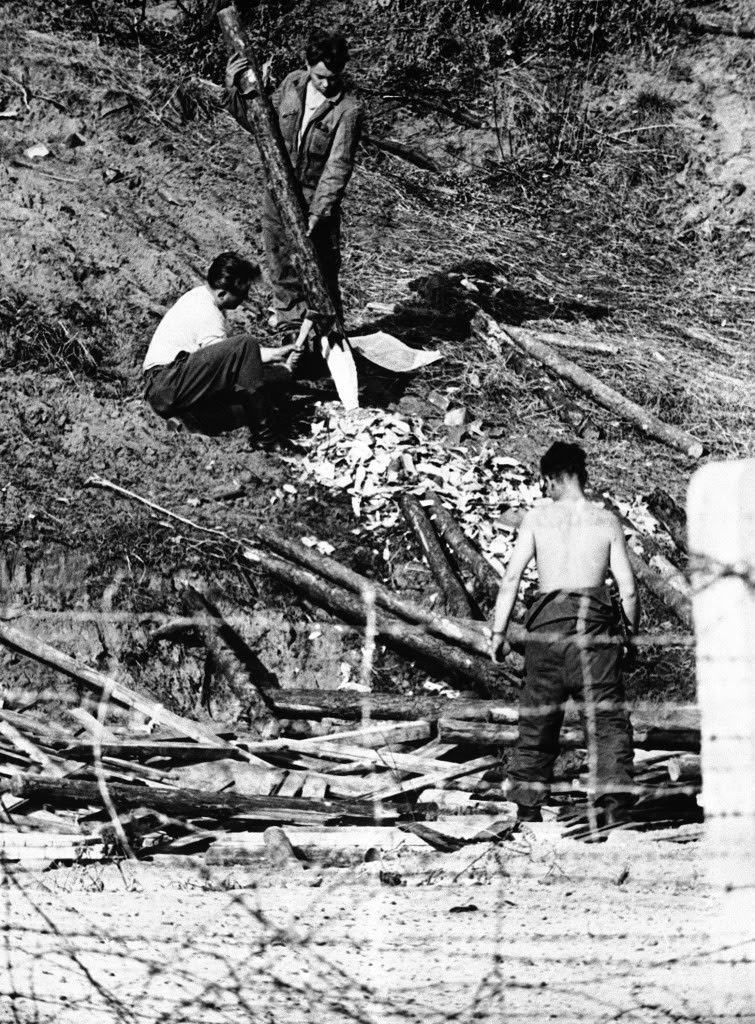
Urgency hangs over the rough earthwork at Berlin’s East–West border in Neukölln-Baumschulenweg, where East German soldiers turn raw timber into sharpened stakes. One man braces a log while another chops, their movements practical and repetitive, surrounded by a scatter of pale wood chips that marks steady progress. The trench itself reads like a hastily drawn line made permanent—muddy slopes, cut branches, and stacked lengths of wood arranged for quick reinforcement.
On Oct. 9, 1961, this kind of labor was part of the accelerating fortification that followed the sudden tightening of the frontier in divided Berlin. Instead of grand monuments, the photo centers on the unglamorous work of border construction: hand tools, improvised materials, and men tasked with transforming landscape into barrier. Barbed wire in the foreground and the churned ground behind it underline how the boundary was being engineered not only to signal separation, but to physically enforce it.
Beyond its immediate scene, the image speaks to the wider Cold War struggle that turned neighborhoods into front lines and ordinary terrain into contested space. For readers searching Berlin Wall history, East German border troops, or the early days of the East–West divide, the photograph offers a stark reminder that walls begin as worksites. The stakes being sharpened here are more than wood—they are the blunt instruments of a city’s fracture, built in a rush and meant to last.