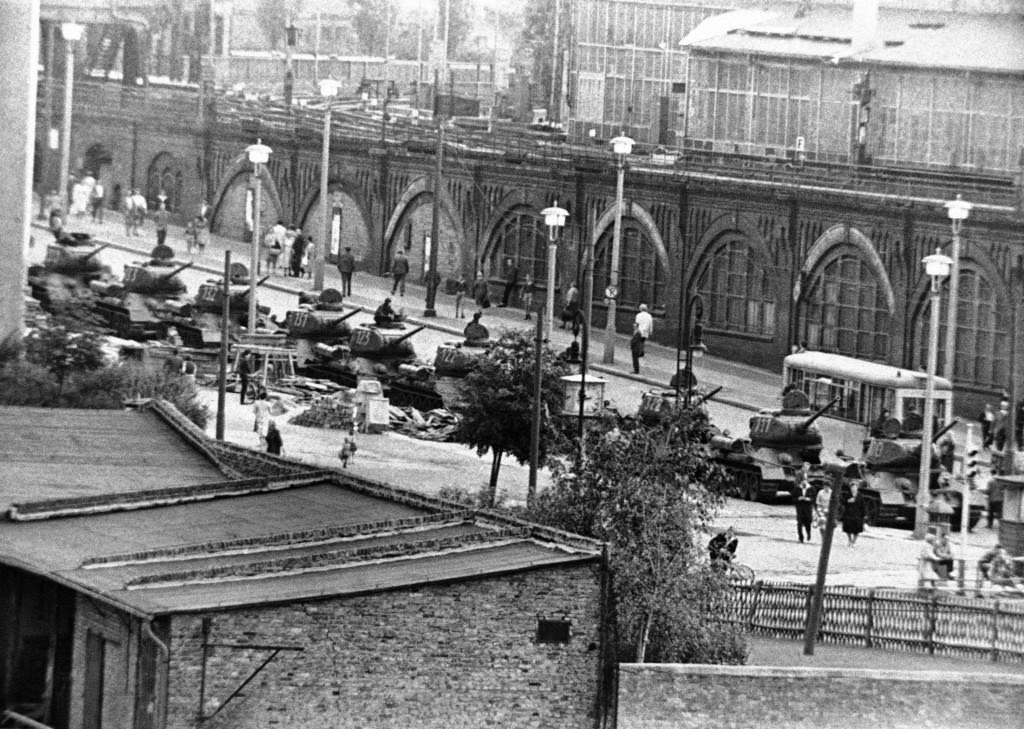
Along the span of Warschauer Bridge in Berlin, a line of East German tanks sits nose-to-tail, turning an everyday transport corridor into a stark military checkpoint. The streetlamps and ironwork of the elevated rail structure frame the convoy, while scattered pedestrians keep their distance, dwarfed by the low, angular silhouettes of armored vehicles. Even without sound, the scene feels heavy—order imposed in steel, with the city’s ordinary rhythms pushed to the margins.
Dated August 13, 1961, the photograph belongs to the first hours of the Berlin Wall era, when barriers and armed presence rapidly reshaped movement across the city. Tanks positioned at such a crossing point underscore how quickly the Cold War could harden into physical control over streets, bridges, and train lines. The tension is visual: civilians navigating around the machinery of the state, and a familiar neighborhood suddenly treated as contested ground.
For readers exploring Berlin history, Cold War Berlin, or the early construction of the Berlin Wall, this image offers more than a record of vehicles—it shows how urban space becomes a front line. The title’s specificity anchors the moment, while the composition reveals everyday details that make the rupture more real: the tracks overhead, the sidewalks below, and people pausing as the world around them changes. “Civil Wars” resonates here not as a battlefield narrative, but as a portrait of division enforced in plain sight.