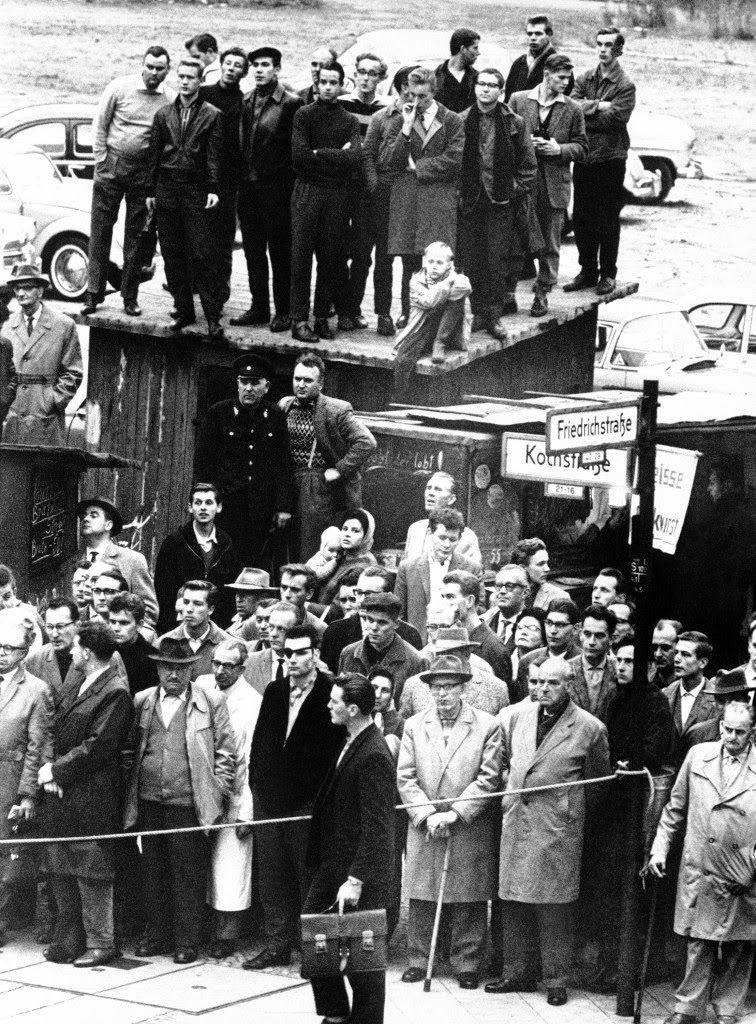
Crowds press toward the U.S. Army checkpoint at Friedrichstrasse, craning for a better view as tension mounts on the street below. Men in coats and hats pack the foreground shoulder to shoulder, while others climb onto a raised platform, turning themselves into an improvised grandstand. A small child perched above the scene underscores how public—and personal—these Cold War confrontations became in divided Berlin.
The title points to a specific flashpoint: an American car and two sightseeing buses barred from entry by Communist East Berlin police on Oct. 25, 1961. In the photograph, the checkpoint area feels less like a border crossing than a stage where authority is tested and watched in real time, with signage for Friedrichstrasse visible amid the crush. The mix of everyday clothing, parked cars, and fixed stares conveys how quickly routine city life could be overtaken by geopolitical crisis.
Seen today, this historical photo reads as a vivid snapshot of West Berliners witnessing the hardening of boundaries shortly after the Berlin Wall went up. It’s an SEO-rich window into Berlin 1961, checkpoint incidents, and the lived experience of the Cold War—when a blocked vehicle or a stopped bus could symbolize far larger struggles over access, movement, and power. The scene’s quiet intensity invites viewers to linger, scanning faces and posture for clues to what it felt like to stand at the edge of a divided world.