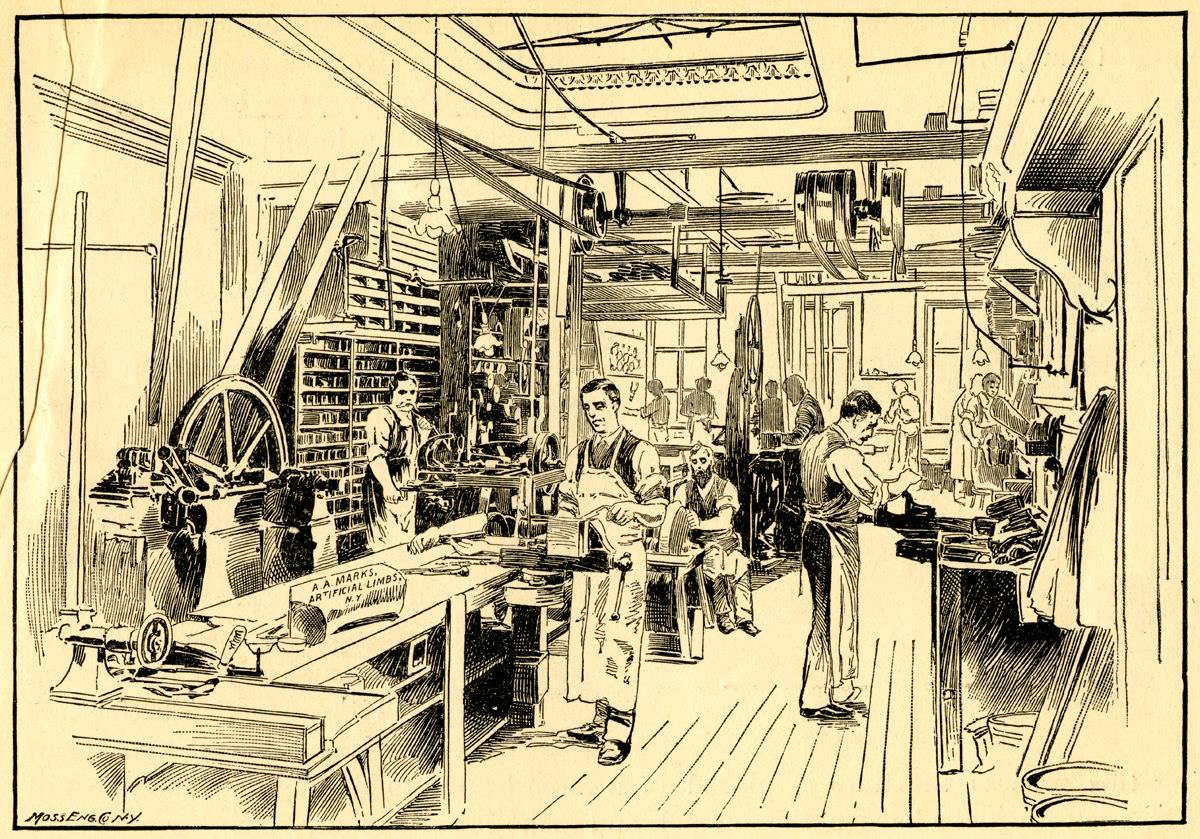
Inside a busy late‑19th‑century workshop, belts and pulleys hang overhead while craftsmen in aprons lean over benches cluttered with tools, forms, and half‑finished parts. A placard on the worktable reads “A. A. Marks, Artificial Limbs, N.Y.,” anchoring the scene in a growing industry that blended woodworking, metalwork, and early mechanical ingenuity. The drawing’s careful detail—machines at the left, racks of components, and workers stationed at different tasks—evokes the factory rhythm behind prosthetic production long before modern plastics and microprocessors.
War and its aftermath sit quietly in the background of this image, even when uniforms are absent. The post title’s note that nearly 150 patents were issued for artificial limb designs between 1861 and 1873 speaks to an era when urgent demand and inventive competition pushed rapid refinement: joints that moved more naturally, feet designed for steadier balance, and attachment systems meant to be worn for long hours. In a Civil War–shadowed economy, prosthetics factories became places where disability, rehabilitation, and industrial manufacturing intersected.
What lingers most is the human scale of the work—men measuring, shaping, and fitting objects intended to restore everyday motion, one limb at a time. Scenes like this help explain why “artificial limbs” became a frequent subject in newspapers, patent filings, and medical conversations of the late 1800s. For readers searching the history of prosthetics, Civil War innovations, or early American manufacturing, the workshop offers a vivid window into how technology, labor, and need reshaped each other in the nineteenth century.